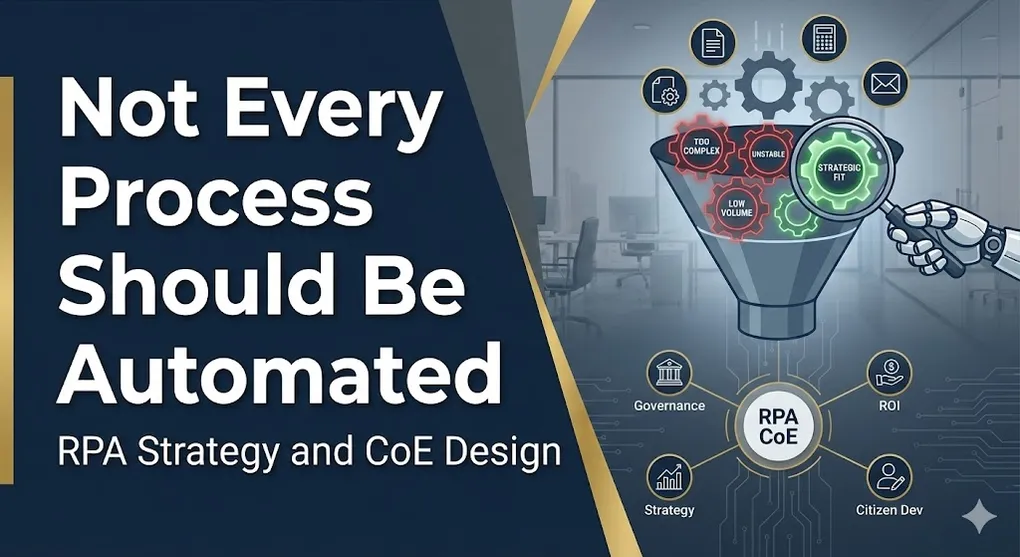
Not Every Process Should Be Automated: The Business Value of a CoE
“We automated 50 processes last year, but nobody uses them.”
This is the most painful sentence a Head of Automation can hear. It usually happens when you measure success by quantity (number of bots) rather than value (hours saved, accuracy improved).
To scale RPA successfully, you need a Center of Excellence (CoE)—a governing body that decides what to automate, how to measure it, and who is responsible.
The Trap: Automating for the Sake of Automation
Not every painful process is a good candidate for RPA.
The Bad Candidate Checklist ❌
- The Process Changes Monthly: Creating a bot for a moving target is a maintenance nightmare.
- Low Volume, High Complexity: Spending 3 months to automate a task that takes 1 hour a month.
- Requires “Human Intuition”: “Just look at the email and decide if the customer owns seems angry.” Bots can’t do feelings (yet).
- Broken Process: Automating a bad process just makes a bad process faster. Optimize first, automate second.
The Solution: The Automation Suitability Matrix
How do you scientifically decide if a process is worth identifying? Use this formula.
Where (each scored 1–5):
- Volume — Transactions per month
- Stability — How often the process changes
- Rule-Based — How deterministic the logic is
- Complexity — Technical difficulty to automate
Scoring Guide
| Metric | 1 (Low) | 5 (High/Best) |
|---|---|---|
| Volume | < 50 / month | > 10,000 / month |
| Stability | Changes weekly | Hasn’t changed in 2 years |
| Rule-Based | ”It depends on the vibe" | "If A then B, always” |
| Complexity | 10 apps, Citrix, Handwriting | Excel + Web, Structured Data |
Decision Rule:
- Score > 15: Green Light. Automate immediately.
- Score 5-15: Yellow Light. Optimize first or wait for higher volume.
- Score < 5: Red Light. Do not automate.
Building an RPA Center of Excellence (CoE)
A CoE isn’t just a bureaucracy; it’s the engine room. It typically consists of these key roles:
1. The Core Roles
| Role | Responsibility |
|---|---|
| RPA Sponsor (Head) | Holds the budget, defines strategy, evangelizes value to the C-suite. |
| Business Analyst (BA) | The bridge. Translates “business speak” into PDDs (Process Definition Docs). Calculates ROI. |
| Solution Architect (SA) | The tech lead. Designs the SDD, ensures scalability, code reviews. |
| RPA Developer | Builds the bots based on SDD. |
| Support / Controller | Monitors the bots in production, handles exceptions (Hypercare). |
2. The Interaction Model
sequenceDiagram
    participant BU as Business Unit
    participant BA as Business Analyst
    participant SA as Solution Architect
    participant Dev as Developer

    Note over BU: Identifies Pain Point
    BU->>BA: Submit Idea

    activate BA
    Note over BA: Check Suitability
    BA->>BA: Feasibility Assessment
    BA->>BA: ROI Calculation
    BA->>SA: Handover for Tech Review
    deactivate BA

    activate SA
    Note over SA: Check Architecture
    SA->>SA: Technical Feasibility
    SA->>SA: Create Implementation Plan
    SA->>Dev: Assign Task
    deactivate SA

    activate Dev
    Dev->>Dev: Build & Test
    Note over Dev: Solution Ready
    deactivate Dev
Calculating ROI: The Math of Automation
ROI isn’t just “we fired 2 people.” (In fact, RPA rarely leads to direct firing; it leads to capacity creation).
The Hard ROI Formula
1. Cost Savings
- Hours Returned: (Time per transaction × Volume) × Hourly Rate
- Error Reduction: Cost of fixing one error × Error rate × Volume
- SLA Penalty Avoidance: Fines saved by processing faster
2. Total Cost of Ownership (TCO)
- License Costs: UiPath/Automation Anywhere/BluePrism licenses
- Infrastructure: Servers, SQL Databases, VMs
- Development Costs: Developer hours × Rate
- Maintenance: Typically 20-30% of development cost per year
Example Calculation
Process: Invoice Processing
- Volume: 2,000 invoices/month
- Time: 10 mins/invoice
- Rate: $30/hour
- Current Cost: (2000 × 10/60) × 10,000 / month = $120,000 / year
Automation Cost:
- License: $8,000 / year
- Dev: $20,000 (one time)
- Maintenance: $5,000 / year
- Total Year 1: $33,000
Year 1 ROI:
- Savings: $120,000 (assuming 100% automation)
- Cost: $33,000
- Net Benefit: $87,000 (263% ROI)
Governance: Stopping “Bot Sprawl”
Without governance, you get “Shadow IT”—random scripts running on people’s desktops that break when a password changes.
CoE Best Practices for Governance
- Centralized Repository: All code must be in Git/SVN. No
.xamlfiles on desktops. - Code Reviews: No bot goes to production without a review by an Architect.
- Strict Access Control: Bots have their own Active Directory accounts (e.g.,
SVC_BotFinance), not user accounts. - Change Management: When SAP updates, the CoE must know before the update, not after the bots crash.
Conclusion
RPA is not a magic wand; it’s a force multiplier.
- Without a CoE: You have a collection of scripts and a headache.
- With a CoE: You have a digital workforce that scales, complies with security policies, and delivers measurable value.
Start with the Matrix. Score your ideas. Build only what matters.