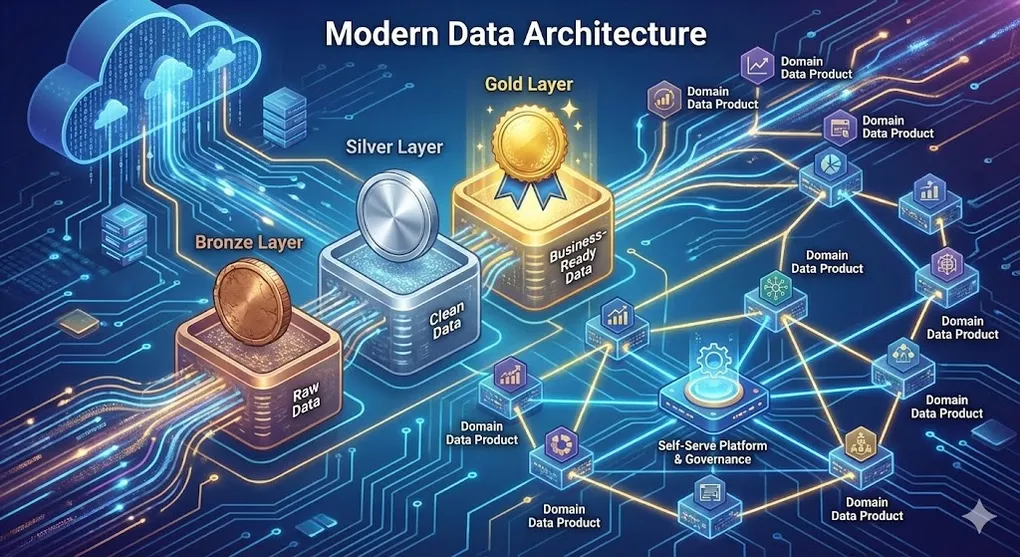
Modern Data Architecture: Medallion, Data Mesh & Beyond
The Modern Challenge
Traditional centralized data teams don’t scale. As organizations grow, they face:
- ⏱️ Bottlenecks: Central team can’t serve all domains
- 🔄 Slow Iterations: Weeks/months for new data products
- 📉 Quality Issues: Teams far from data don’t understand it
- 🏢 Silos: Departments build shadow data systems
Modern architectures address these through layered organization (Medallion) and decentralized ownership (Data Mesh).
The Underlying Principle: Separation of Concerns (SoC)
Both Medallion and Data Mesh embody the software engineering principle of Separation of Concerns:
| Architecture | SoC Application |
|---|---|
| Medallion | Each layer has ONE job: Bronze (ingest), Silver (clean), Gold (serve) |
| Data Mesh | Each domain owns its data end-to-end, platform provides shared infrastructure |
| Combined | Clear boundaries prevent “spaghetti pipelines” where everything depends on everything |
Why SoC Matters in Data: Without clear separation, a schema change in Bronze breaks Gold reports. With SoC, each layer acts as a contract boundary—changes are isolated and testable.
1. Medallion Architecture
Definition
Medallion Architecture is a data design pattern that organizes data into progressive layers of quality and refinement: Bronze → Silver → Gold.
The Three Layers
┌─────────────────────────────────────────────────────────────────┐
│                    Medallion Architecture                        │
├─────────────────────────────────────────────────────────────────┤
│                                                                  │
│  ┌──────────┐    ┌──────────┐    ┌──────────┐    ┌──────────┐  │
│  │  Source  │───▶│  Bronze  │───▶│  Silver  │───▶│   Gold   │  │
│  │ Systems  │    │   (Raw)  │    │ (Clean)  │    │  (Mart)  │  │
│  └──────────┘    └──────────┘    └──────────┘    └──────────┘  │
│                        │              │              │          │
│                        ▼              ▼              ▼          │
│                   Raw Data       Processed      Business-       │
│                   Exact Copy     Validated      Ready Data      │
│                                                                  │
└─────────────────────────────────────────────────────────────────┘
🥉 Bronze Layer (Raw / Landing)
| Aspect | Description |
|---|---|
| Purpose | Preserve raw data exactly as received |
| Content | JSON, CSV, Parquet dumps, API responses |
| Transformations | Minimal: add ingestion timestamp, source metadata |
| Schema | Schema-on-read or inferred |
| Retention | Long-term (years) for replay/audit |
-- Bronze table example
CREATE TABLE bronze.raw_orders (
    _ingestion_timestamp TIMESTAMP,
    _source_file STRING,
    _raw_data STRING  -- Original JSON/payload
);

-- Or structured but raw
CREATE TABLE bronze.orders (
    order_id STRING,
    customer_id STRING,
    order_date STRING,      -- Still string, not parsed
    amount STRING,          -- Still string
    _ingestion_ts TIMESTAMP,
    _source STRING
);
Why keep raw data?
- 🔄 Replayability: Re-process if logic changes
- 🔍 Debugging: Trace issues to source
- ⚖️ Compliance: Audit trail for regulators
- 📊 Flexibility: Build new Silver tables without re-ingesting
🥈 Silver Layer (Clean / Staging)
| Aspect | Description |
|---|---|
| Purpose | Single source of truth, cleaned and validated |
| Content | Typed, deduplicated, standardized tables |
| Transformations | Parsing, casting, deduplication, validation |
| Schema | Enforced, documented |
| Consumers | Analysts, data scientists, Gold layer |
-- Silver table: cleaned, typed, deduplicated
CREATE TABLE silver.orders (
    order_id INT PRIMARY KEY,
    customer_id INT NOT NULL,
    order_date DATE NOT NULL,
    amount DECIMAL(12,2),
    currency VARCHAR(3),
    status VARCHAR(20),
    _loaded_at TIMESTAMP,
    _updated_at TIMESTAMP
);

-- Transformation from Bronze to Silver
INSERT INTO silver.orders
SELECT
    CAST(order_id AS INT),
    CAST(customer_id AS INT),
    PARSE_DATE(order_date),
    CAST(amount AS DECIMAL(12,2)),
    UPPER(TRIM(currency)),
    status,
    CURRENT_TIMESTAMP,
    CURRENT_TIMESTAMP
FROM bronze.orders
WHERE order_id IS NOT NULL
QUALIFY ROW_NUMBER() OVER (PARTITION BY order_id ORDER BY _ingestion_ts DESC) = 1;
Silver Layer Responsibilities:
- ✅ Data type casting
- ✅ Null handling
- ✅ Deduplication
- ✅ Standardization (formats, codes)
- ✅ Data quality checks
- ✅ Soft deletes / SCD handling
🥇 Gold Layer (Serve / Mart)
| Aspect | Description |
|---|---|
| Purpose | Business-ready, optimized for consumption |
| Content | Aggregated KPIs, Star Schemas, feature tables |
| Transformations | Business logic, aggregations, dimensional modeling |
| Schema | Star/Snowflake Schema |
| Consumers | BI tools, executives, ML models |
-- Gold table: aggregated, business-ready
CREATE TABLE gold.daily_sales_summary (
    date_key INT REFERENCES gold.dim_date(date_key),
    store_key INT REFERENCES gold.dim_store(store_key),
    product_category VARCHAR(50),
    total_orders INT,
    total_revenue DECIMAL(15,2),
    avg_order_value DECIMAL(10,2),
    unique_customers INT,
    _computed_at TIMESTAMP
);

-- Gold transformation
INSERT INTO gold.daily_sales_summary
SELECT
    d.date_key,
    s.store_key,
    p.category,
    COUNT(*) as total_orders,
    SUM(o.amount) as total_revenue,
    AVG(o.amount) as avg_order_value,
    COUNT(DISTINCT o.customer_id) as unique_customers,
    CURRENT_TIMESTAMP
FROM silver.orders o
JOIN gold.dim_date d ON o.order_date = d.full_date
JOIN gold.dim_store s ON o.store_id = s.store_id
JOIN gold.dim_product p ON o.product_id = p.product_id
GROUP BY d.date_key, s.store_key, p.category;
Gold Layer Patterns:
- ⭐ Star Schema: Fact + Dimension tables (Kimball)
- 📊 Wide Tables: Pre-joined, denormalized for specific use cases
- 🤖 Feature Store: ML-ready feature tables
- 📈 Aggregates: Pre-computed KPIs and metrics
Semantic Layer Trend (2024-2025): To prevent “What is Revenue?” debates (different definitions across departments), modern stacks add a Semantic Layer (Metric Store) on top of Gold:
- Tools: dbt Semantic Layer, Cube, Looker, Metricflow
- Purpose: Single source of truth for metric definitions, consumed by all BI tools
- Pattern:
Gold Tables → Semantic Layer → BI Dashboards
Layer Comparison
| Aspect | Bronze | Silver | Gold |
|---|---|---|---|
| Data Quality | As-is | Validated | Business-ready |
| Schema | Loose | Enforced | Optimized |
| Transformations | None | Technical | Business logic |
| Consumers | Engineers | Analysts, DS | BI, Executives |
| Query Pattern | Rare | Exploratory | High-frequency |
| Update Frequency | Real-time / micro-batch | Near real-time | Scheduled batch |
dbt Implementation
models/
├── staging/          # Bronze → Silver
│   ├── stg_orders.sql
│   └── stg_customers.sql
├── intermediate/     # Silver transformations
│   └── int_orders_enriched.sql
└── marts/           # Gold layer
    ├── dim_customer.sql
    ├── dim_product.sql
    └── fct_sales.sql
-- models/staging/stg_orders.sql
{{ config(materialized='view') }}
SELECT
order_id::int as order_id,
customer_id::int as customer_id,
order_date::date as order_date,
amount::decimal(12,2) as amount,
UPPER(TRIM(status)) as status
FROM {{ source('raw', 'orders') }}
WHERE order_id IS NOT NULL
-- models/marts/fct_sales.sql
{{ config(materialized='table') }}
SELECT
{{ dbt_utils.generate_surrogate_key(['o.order_id']) }} as sale_key,
d.date_key,
c.customer_key,
p.product_key,
o.quantity,
o.amount as revenue
FROM {{ ref('stg_orders') }} o
JOIN {{ ref('dim_date') }} d ON o.order_date = d.full_date
JOIN {{ ref('dim_customer') }} c ON o.customer_id = c.customer_id
JOIN {{ ref('dim_product') }} p ON o.product_id = p.product_idMulti-hop Architecture: How Many Layers?
The standard Medallion pattern uses 3 layers, but real-world complexity may require more or fewer.
Layer Spectrum
Simplest              Standard Medallion           Complex Enterprise
    │                        │                            │
    ▼                        ▼                            ▼
┌─────────┐           ┌─────────────────┐          ┌─────────────────────┐
│ Raw→Gold│           │Bronze→Silver→Gold│          │Bronze→Silver→Silver+│
│ (2 hop) │           │    (3 hop)      │          │  →Gold→Gold+        │
└─────────┘           └─────────────────┘          │    (4-5 hop)        │
                                                    └─────────────────────┘
Layer Count Decision Matrix
| Scenario | Recommended Hops | Reason |
|---|---|---|
| Simple BI reporting | 2 (Raw → Mart) | Low complexity, fast delivery |
| Standard analytics platform | 3 (Bronze/Silver/Gold) | Balance flexibility & maintenance |
| Multi-source integration | 3-4 | Split Silver: cleaned + integrated |
| Multi-consumer requirements | 3-4 | Split Gold: core + dept_specific |
| Strict regulatory environment | 4+ | Additional audit/compliance layer |
Signals to Add More Layers
| Signal | Action |
|---|---|
| Silver models too complex | Split into silver_stg + silver_conform |
| Multiple Gold tables repeat same JOINs | Add Intermediate layer |
| Different departments need different granularity | Add department-specific Gold |
| Need complete audit trail | Add archive layer |
dbt Common Layer Structure
models/
├── staging/       # Bronze → Silver (1st hop)
├── intermediate/  # Silver → Silver (2nd hop) ← Optional
├── marts/         # Silver → Gold (3rd hop)
│   ├── core/      # Shared Gold
│   └── finance/   # Department-specific Gold (4th hop)
└── reports/       # Pre-aggregated reports (5th hop) ← Optional
Rule of Thumb: Start with 3 layers. Add more only when you see clear signals of complexity. Each additional layer increases maintenance overhead.
2. Data Mesh
Definition
Data Mesh is a sociotechnical approach that decentralizes data ownership to domain teams while providing a self-serve infrastructure.
Created by Zhamak Dehghani at Thoughtworks (2019)
The Four Principles
┌─────────────────────────────────────────────────────────────────┐
│                    Data Mesh Principles                          │
├─────────────────────────────────────────────────────────────────┤
│                                                                  │
│  ┌────────────────────┐    ┌────────────────────┐              │
│  │  1. Domain         │    │  2. Data as a      │              │
│  │     Ownership      │    │     Product        │              │
│  │                    │    │                    │              │
│  │  Teams own their   │    │  Treat data like   │              │
│  │  domain's data     │    │  a product with    │              │
│  │                    │    │  SLAs & docs       │              │
│  └────────────────────┘    └────────────────────┘              │
│                                                                  │
│  ┌────────────────────┐    ┌────────────────────┐              │
│  │  3. Self-Serve     │    │  4. Federated      │              │
│  │     Platform       │    │     Governance     │              │
│  │                    │    │                    │              │
│  │  Infrastructure    │    │  Global standards, │              │
│  │  teams can use     │    │  local autonomy    │              │
│  │  independently     │    │                    │              │
│  └────────────────────┘    └────────────────────┘              │
│                                                                  │
└─────────────────────────────────────────────────────────────────┘
Principle 1: Domain Ownership
Teams that create/understand the data own and serve it.
Traditional (Centralized):
┌──────────┐         ┌──────────────────┐         ┌──────────┐
│  Sales   │────────▶│   Central Data   │────────▶│  All     │
│  Team    │         │      Team        │         │ Consumers│
└──────────┘         │                  │         └──────────┘
┌──────────┐         │   (Bottleneck)   │
│ Marketing│────────▶│                  │
└──────────┘         └──────────────────┘
Data Mesh (Decentralized):
┌─────────────────┐                      ┌──────────┐
│   Sales Domain  │─────────────────────▶│          │
│   (owns sales   │                      │ Marketing│
│    data)        │                      │ Domain   │
└─────────────────┘                      │          │
         │                               └──────────┘
         │                                    │
         ▼                                    ▼
┌─────────────────┐                      ┌──────────┐
│ Marketing Domain│◀─────────────────────│  Sales   │
│ (owns marketing │                      │  Domain  │
│  data)          │                      │          │
└─────────────────┘                      └──────────┘
Principle 2: Data as a Product
Each domain publishes data products with product management discipline.
| Characteristic | Description |
|---|---|
| Discoverable | Listed in data catalog with metadata |
| Addressable | Clear endpoint/path to access |
| Trustworthy | Quality SLAs, freshness guarantees |
| Self-describing | Schema, lineage, documentation |
| Interoperable | Standard formats, global IDs |
| Secure | Access controls, privacy compliance |
# Example: Data Product Contract
name: sales.orders
version: 2.0.0
owner: sales-data-team@company.com
description: All completed customer orders

schema:
  - name: order_id
    type: integer
    description: Unique identifier
  - name: customer_id
    type: integer
    description: FK to customers.customer_id

sla:
  freshness: 1 hour
  completeness: 99.9%
  availability: 99.5%

access:
  public: true
  pii: false
Data Contracts = “Shift Left” for Data
Just as software engineering shifted testing left (earlier in the pipeline), Data Contracts shift data quality left:
- Without Contracts: Upstream team changes schema → downstream pipelines break → data team discovers days later
- With Contracts: Schema change fails contract validation → caught in CI/CD before deployment
Data Contracts are the bridge between Microservices and the Data Platform. They prevent software engineers from accidentally breaking data pipelines with schema changes.
Principle 3: Self-Serve Platform
A data platform that enables domain teams to build/ship data products independently.
┌─────────────────────────────────────────────────────────────────┐
│                    Self-Serve Data Platform                      │
├─────────────────────────────────────────────────────────────────┤
│                                                                  │
│  ┌──────────────────────────────────────────────────────┐       │
│  │                   Domain Teams Use                    │       │
│  ├──────────────────────────────────────────────────────┤       │
│  │  Data Product Templates  │  CI/CD Pipelines          │       │
│  │  Quality Frameworks      │  Access Control           │       │
│  │  Schema Registry         │  Data Catalog             │       │
│  └──────────────────────────────────────────────────────┘       │
│                          │                                       │
│                          ▼                                       │
│  ┌──────────────────────────────────────────────────────┐       │
│  │                 Platform Team Provides                │       │
│  ├──────────────────────────────────────────────────────┤       │
│  │  Compute (Spark/DBT)     │  Storage (Lakehouse)      │       │
│  │  Orchestration           │  Observability            │       │
│  │  Data Mesh Infra         │  Security/Governance      │       │
│  └──────────────────────────────────────────────────────┘       │
│                                                                  │
└─────────────────────────────────────────────────────────────────┘
Principle 4: Federated Computational Governance
Balance between global standards and local autonomy.
| Global (Federated) | Local (Domain) |
|---|---|
| Naming conventions | Schema design |
| Data quality minimums | Quality tests |
| PII handling rules | Business logic |
| Interoperability standards | Implementation |
| Audit requirements | Development pace |
Data Mesh Challenges
| Challenge | Mitigation |
|---|---|
| Coordination overhead | Strong platform team, clear contracts |
| Skill gaps | Training, embedded data engineers |
| Inconsistent quality | Automated quality gates |
| Discovery complexity | Robust data catalog |
| Governance complexity | Clear ownership, federated policies |
When to Use Data Mesh
| ✅ Good Fit | ❌ Poor Fit |
|---|---|
| Large organization (>100 engineers) | Small team (<20) |
| Multiple distinct domains | Single product/domain |
| Domain teams have data skills | No data skills in domains |
| Bottleneck at central data team | Central team working fine |
| Need for speed + scale | Simple analytics needs |
3. Combining Medallion + Data Mesh
The architectures complement each other:
┌─────────────────────────────────────────────────────────────────┐
│                  Medallion + Data Mesh                           │
├─────────────────────────────────────────────────────────────────┤
│                                                                  │
│  ┌─────────────────────────────────────────────────────┐        │
│  │               Sales Domain                           │        │
│  │  ┌─────────┐  ┌─────────┐  ┌─────────┐              │        │
│  │  │ Bronze  │─▶│ Silver  │─▶│  Gold   │ ◀── Product  │        │
│  │  └─────────┘  └─────────┘  └─────────┘              │        │
│  └─────────────────────────────────────────────────────┘        │
│                          │                                       │
│                          │ Published Data Product                │
│                          ▼                                       │
│  ┌─────────────────────────────────────────────────────┐        │
│  │             Marketing Domain                         │        │
│  │  ┌─────────┐  ┌─────────┐  ┌─────────┐              │        │
│  │  │ Bronze  │─▶│ Silver  │─▶│  Gold   │ ◀── Product  │        │
│  │  │(consumes│  └─────────┘  └─────────┘              │        │
│  │  │ Sales)  │                                         │        │
│  │  └─────────┘                                         │        │
│  └─────────────────────────────────────────────────────┘        │
│                                                                  │
└─────────────────────────────────────────────────────────────────┘
Implementation Pattern
- Each domain has its own Medallion layers (Bronze/Silver/Gold)
- Gold layer tables are the published Data Products
- Cross-domain consumption: Domain B’s Bronze can ingest Domain A’s Gold
- Platform provides shared tooling, catalog, governance
4. Tool Ecosystem
Platform Components
┌─────────────────────────────────────────────────────────────────┐
│                   Modern Data Platform Stack                     │
├─────────────────────────────────────────────────────────────────┤
│                                                                  │
│  ┌───────────────┐  ┌───────────────┐  ┌───────────────┐        │
│  │   Ingestion   │  │   Storage     │  │  Transform    │        │
│  ├───────────────┤  ├───────────────┤  ├───────────────┤        │
│  │ Fivetran      │  │ Databricks    │  │ dbt           │        │
│  │ Airbyte       │  │ Snowflake     │  │ Spark         │        │
│  │ Debezium      │  │ Delta Lake    │  │ SQLMesh       │        │
│  └───────────────┘  └───────────────┘  └───────────────┘        │
│                                                                  │
│  ┌───────────────┐  ┌───────────────┐  ┌───────────────┐        │
│  │ Orchestration │  │   Catalog     │  │   Quality     │        │
│  ├───────────────┤  ├───────────────┤  ├───────────────┤        │
│  │ Dagster       │  │ DataHub       │  │ Great Expect. │        │
│  │ Airflow       │  │ Atlan         │  │ Soda          │        │
│  │ Prefect       │  │ Unity Catalog │  │ Monte Carlo   │        │
│  └───────────────┘  └───────────────┘  └───────────────┘        │
│                                                                  │
└─────────────────────────────────────────────────────────────────┘
Orchestration Deep Dive: Airflow vs Prefect
Two popular orchestration tools with different philosophies:
| Aspect | Apache Airflow | Prefect |
|---|---|---|
| Philosophy | DAGs as configuration | Python-first, decorators |
| Created | 2014 (Airbnb) | 2018 |
| Definition Style | Python + explicit DAG class | @flow / @task decorators |
| Dynamic DAGs | Requires workarounds | Native support |
| Local Development | Requires full setup | Simple python script.py |
| Managed Cloud | Astronomer, MWAA, GCP Composer | Prefect Cloud (free tier) |
| Ecosystem | Very mature, many plugins | Newer but growing fast |
| Learning Curve | Medium-high | Lower |
Code Comparison
Airflow:
from airflow import DAG
from airflow.operators.python import PythonOperator
from datetime import datetime

def extract(): ...
def transform(): ...

with DAG('etl_pipeline', start_date=datetime(2024,1,1), schedule='@daily') as dag:
    t1 = PythonOperator(task_id='extract', python_callable=extract)
    t2 = PythonOperator(task_id='transform', python_callable=transform)
    t1 >> t2
Prefect:
from prefect import flow, task

@task
def extract(): ...

@task
def transform(data): ...

@flow(name="etl_pipeline")
def etl():
    data = extract()
    transform(data)

if __name__ == "__main__":
    etl()
When to Choose
| Choose Airflow | Choose Prefect |
|---|---|
| Enterprise with Airflow experience | New projects, rapid iteration |
| Need extensive connectors | Python-focused team |
| Using managed services (GCP/AWS) | Want simple local development |
| Long-term stable project | Dynamic workflows |
Data Mesh Specific Tools
| Category | Tools |
|---|---|
| Data Product Management | Datamesh Manager, DataOS |
| Data Contracts | Soda, datacontract CLI |
| Federated Catalog | DataHub, Atlan, Collibra |
| Self-Serve Platform | Databricks Unity Catalog, Starburst Galaxy |
5. Decision Framework
Architecture Selection
┌─────────────────────────────────────────────────────────────────┐
│                   Architecture Decision                          │
├─────────────────────────────────────────────────────────────────┤
│                                                                  │
│  Organization Size?                                              │
│      │                                                           │
│      ├── Small (<20 data people)                                │
│      │       └──▶ Medallion (centralized)                       │
│      │                                                           │
│      ├── Medium (20-100)                                        │
│      │       └──▶ Medallion + domain alignment                  │
│      │                                                           │
│      └── Large (100+)                                           │
│              │                                                   │
│              ├── Domains have data skills?                      │
│              │       │                                           │
│              │       ├── Yes ──▶ Full Data Mesh                 │
│              │       └── No ──▶ Medallion + gradual shift       │
│              │                                                   │
│              └── Central team bottleneck?                       │
│                      │                                           │
│                      ├── Yes ──▶ Data Mesh                      │
│                      └── No ──▶ Medallion (centralized)         │
│                                                                  │
└─────────────────────────────────────────────────────────────────┘
FinOps Warning: The Hidden Cost of Decentralization
Data Mesh and distributed Lakehouse architectures bring agility but can cause cost explosion:
| Risk | Cause | Mitigation |
|---|---|---|
| Duplicate compute | Multiple domains running similar queries | Shared intermediate tables, cross-domain marts |
| Unoptimized queries | Domain teams lack SQL optimization skills | Query analysis tools, training, guardrails |
| Storage sprawl | Every team creates copies “just in case” | Data lifecycle policies, automated cleanup |
| Uncapped serverless | Snowflake/BigQuery pay-per-query | Budget alerts, query cost limits |
Platform Team Responsibility: Provide Cost Observability dashboards showing:
- Per-domain compute/storage costs
- Cost trends and anomalies
- Query efficiency metrics
- Tools: Snowflake Cost Management, Databricks Cost Explorer, select star, Zenith
6. Summary: The City Analogy 🏙️
| Concept | City Analogy |
|---|---|
| Medallion | Highway system (Raw imports → Processing zones → Downtown business) |
| Bronze | Port/Airport (raw goods arrive as-is) |
| Silver | Warehouses (quality checked, sorted, standardized) |
| Gold | Retail stores (consumer-ready products) |
| Data Mesh | City districts (each district manages its own services, follows city codes) |
| Self-Serve Platform | City utilities (water, power everyone can connect to) |
| Federated Governance | City laws (global building codes, local zoning) |
Key Takeaways
- Medallion Architecture provides a clear layer pattern for data quality progression
- Data Mesh decentralizes ownership while maintaining interoperability
- They work together: Medallion as the pattern, Mesh as the organizational model
- Start simple: Begin with Medallion, evolve to Mesh as organization scales
- Platform is key: Self-serve infrastructure enables both patterns