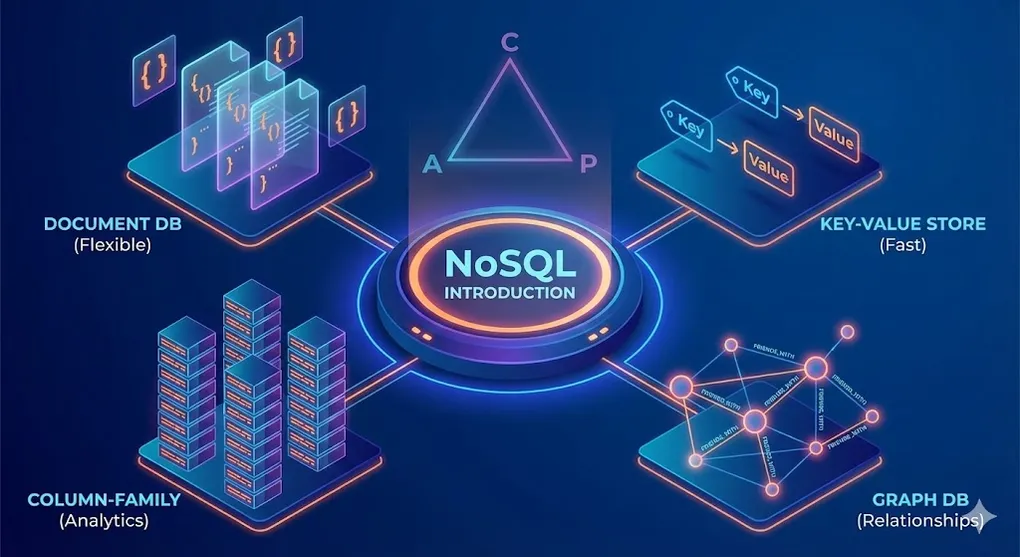
NoSQL Introduction: Types, CAP Theorem & Storage Engines
Prerequisites: Understanding of relational databases. See DB 02 Software Layer for SQL fundamentals.
NoSQL databases were created to solve problems that traditional SQL databases struggle with: massive scale, flexible schemas, and distributed computing.
Part A: The Four Types of NoSQL
1. Document Database
Structure: JSON-like documents (nested, flexible)
{
  "_id": "user123",
  "name": "Alice",
  "orders": [
    { "item": "Laptop", "price": 1200 },
    { "item": "Mouse", "price": 25 }
  ]
}| Product | Use Case |
|---|---|
| MongoDB | Content management, e-commerce catalogs |
| Couchbase | Mobile apps with offline sync |
Why use it: When your data has variable structure (products with different attributes).
2. Key-Value Store
Structure: Simple dictionary — key → value
session:abc123 → { userId: 1, expires: "2024-03-15" }
cache:product:99 → { name: "Laptop", price: 1200 }| Product | Use Case |
|---|---|
| Redis | Caching, session storage, real-time leaderboards |
| DynamoDB | Serverless apps, high-throughput workloads |
Why use it: Blazing fast reads/writes for simple lookups.
3. Column-Family Store
Structure: Data stored by columns, not rows
| Product | Use Case |
|---|---|
| Cassandra | Time-series data, IoT sensor logs, high-velocity writes |
| HBase | Hadoop ecosystem, log data ingestion |
Why use it: Excellent write throughput and handling of sparse data. (Note: For pure analytical aggregations, consider Column-Oriented DBs like ClickHouse.)
4. Graph Database
Structure: Nodes (entities) + Edges (relationships)
| Product | Use Case |
|---|---|
| Neo4j | Social networks, fraud detection |
| Amazon Neptune | Knowledge graphs, recommendation engines |
Why use it: Finding relationships is O(1) via index-free adjacency — each node directly points to its neighbors without index lookups, unlike SQL JOINs that must scan indexes.
5. Comparison Summary
| Type | Data Model | Best For | Example Query |
|---|---|---|---|
| Document | JSON objects | Flexible schemas | ”Get user with all their orders” |
| Key-Value | Key → Value | Caching | ”Get session by ID” |
| Column | Column families | Analytics | ”Sum of all sales this month” |
| Graph | Nodes + Edges | Relationships | ”Friends who also bought X” |
Part B: CAP Theorem
6. The Impossible Triangle
In a distributed system, you can only guarantee two of three properties:
💡 Modern Understanding of CAP
In reality, P (Partition Tolerance) is non-negotiable — networks WILL fail. So when a partition occurs, you must choose between C (Consistency) and A (Availability). “Pick 2” is a simplification; the real choice is C vs A during network failures.
| Combination | Sacrifice | Example |
|---|---|---|
| CA | Partition Tolerance | Traditional SQL (single server) |
| CP | Availability | MongoDB (with strict write concern) |
| AP | Consistency | Cassandra, DynamoDB |
7. Real-World Example
Scenario: Network splits your 3 MongoDB servers into two groups.
Part C: BASE vs ACID
8. ACID (SQL Databases)
| Property | Meaning | Example |
|---|---|---|
| Atomicity | All or nothing | Bank transfer: both debit and credit succeed, or neither |
| Consistency | Valid state → Valid state | Total money in system stays same |
| Isolation | Transactions don’t interfere | Two users can’t buy the last item |
| Durability | Once committed, permanent | Survives power failure |
9. BASE (NoSQL Databases)
| Property | Meaning |
|---|---|
| Basically Available | System always responds (maybe stale data) |
| Soft state | Data may change over time (syncing) |
| Eventual consistency | Given time, all nodes will agree |
10. Comparison
| ACID | BASE | |
|---|---|---|
| Priority | Correctness | Availability |
| Scale | Harder to scale out | Built for scale out |
| Use Case | Banking, inventory | Social feeds, analytics |
Part D: MongoDB Storage Engine (WiredTiger)
11. What is WiredTiger?
WiredTiger is MongoDB’s default storage engine since version 3.2. Think of it as the “V8 engine” that powers MongoDB.
12. Document-Level Locking
The Problem: Early MongoDB used database-level locking — if one user writes, the entire database is locked.
WiredTiger’s Solution: Document-level locking — only the specific document being modified is locked.
💡 MVCC: Why Reads Don’t Block Writes
WiredTiger uses MVCC (Multi-Version Concurrency Control): readers see the old version while writers create a new version. This is why reads and writes don’t block each other — true non-blocking concurrency.
13. Compression
WiredTiger compresses data on disk:
| Compression | CPU Usage | Space Savings |
|---|---|---|
| snappy (default) | Low | ~50% |
| zlib | Medium | ~70% |
| zstd | Low-Medium | ~60% |
// Check current engine
db.serverStatus().storageEngine
// { "name": "wiredTiger", ... }
14. Journaling & Checkpoints
| Feature | Purpose |
|---|---|
| Journal | Write-ahead log (WAL) for crash recovery |
| Checkpoint | Periodic flush to disk (every 60s or 2GB) |
This is similar to SQL Server’s transaction log!
Summary
NoSQL Type Selection Guide
| Need | Choose |
|---|---|
| Flexible product catalog | Document (MongoDB) |
| Super-fast caching | Key-Value (Redis) |
| Time-series / IoT data | Column (Cassandra) |
| Social network relationships | Graph (Neo4j) |
CAP/BASE Quick Reference
| Concept | Meaning |
|---|---|
| CAP | Pick 2: Consistency, Availability, Partition Tolerance |
| CP | Strong consistency, sacrifice availability during partition |
| AP | Always available, sacrifice consistency during partition |
| BASE | Eventual consistency model for distributed systems |
WiredTiger Benefits
- ✅ Document-level locking (high concurrency)
- ✅ Compression (50-70% space savings)
- ✅ Journaling (crash recovery)
💡 Practice Questions
Conceptual
-
Name the 4 types of NoSQL databases and give one use case for each.
-
Explain the CAP theorem. Why can’t a distributed system have all three properties?
-
What is the difference between ACID and BASE consistency models?
-
Describe two features of MongoDB’s WiredTiger storage engine.
Scenario
-
Decision: Your company needs to build a social network. Which NoSQL database type would you recommend for storing friend relationships, and why?
-
Trade-off: An e-commerce site needs both fast reads and strong consistency for inventory counts. According to CAP theorem, what challenges might you face with a distributed database?