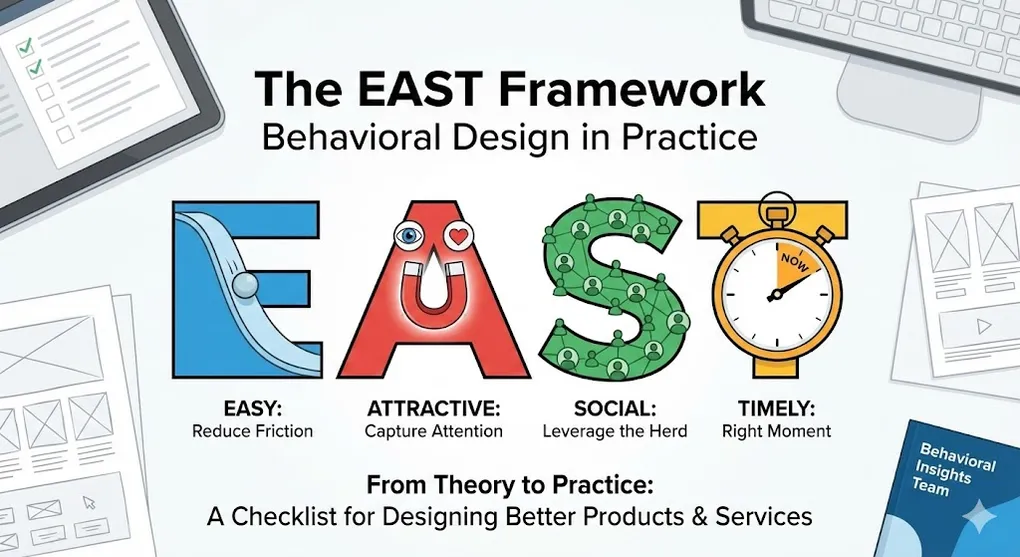
The EAST Framework: Behavioral Design in Practice
From Theory to Practice
We’ve explored the cognitive biases that drive human behavior. But how do you apply these insights to real products, policies, and services?
Enter the EAST Framework—developed by the UK Government’s Behavioural Insights Team (also known as the “Nudge Unit”).
EAST: Make it Easy, Attractive, Social, Timely.
This framework transforms abstract behavioral science into a practical design checklist.
The EAST Framework Explained
| Dimension | Core Question | Key Insight |
|---|---|---|
| Easy | Is there friction? | Reduce steps, simplify choices, use defaults |
| Attractive | Does it grab attention? | Make benefits salient, personalize, design for loss aversion |
| Social | What are others doing? | Leverage social proof, networks, commitments |
| Timely | Is this the right moment? | Intervene at receptive moments, consider present bias |
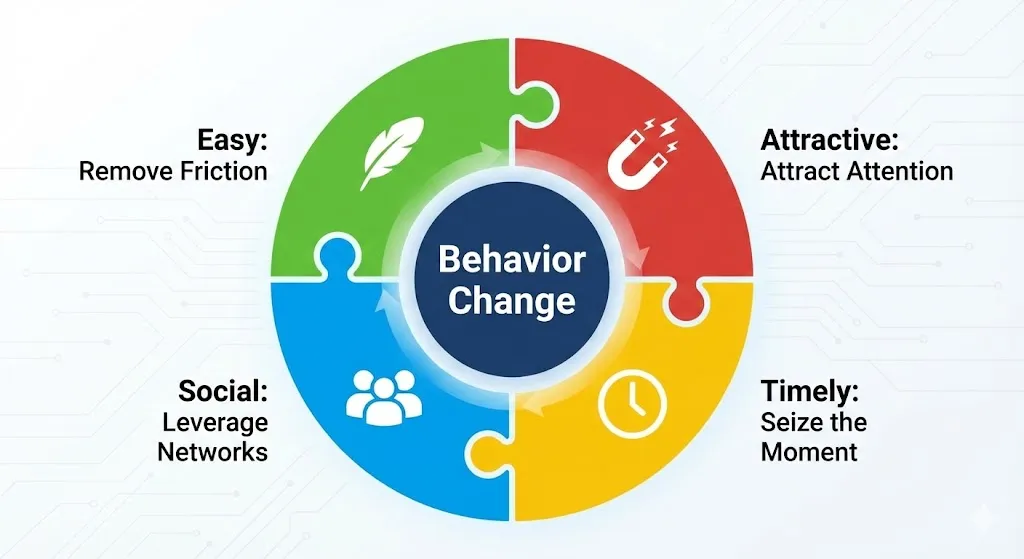
E — Easy: Reduce Friction
Principle: The path of least resistance wins. Every additional step loses users.
The Power of Defaults
| Without Default | With Default |
|---|---|
| ”Check this box to subscribe" | "Uncheck to opt out” |
| 3% organ donation rate (opt-in countries) | 85%+ rate (opt-out countries) |
| Low 401(k) enrollment | Auto-enrollment achieves 90%+ |
Why it works: Defaults exploit our inertia. Changing requires effort; doing nothing is easy.
Simplification Tactics
| Friction | Easy Fix |
|---|---|
| Long signup form | Ask only essentials; progressive disclosure |
| Complex instructions | Visual guides, step-by-step wizards |
| Too many choices | Curated recommendations, “Most Popular” |
| Paperwork | Digital forms with auto-fill |
Case Study: UK Tax Letters
Before: Standard tax reminder letter → 57% payment rate
After: Simplified letter with clear action steps → 67% payment rate
Savings: £30 million recovered annually from this single change.
When Friction is Good: Positive Friction
Not all friction should be removed. Sometimes we want users to slow down:
| Scenario | Positive Friction | Purpose |
|---|---|---|
| Large bank transfer | 2FA + confirmation screen | Prevent costly errors |
| Delete account | ”Type DELETE to confirm” | Prevent impulsive decisions |
| Cancel subscription | ”Are you sure?” + alternatives | Reduce regret |
| Send angry email | ”Undo” delay | Allow System 2 to catch up |
Design Wisdom: Remove friction for desired behaviors. Add friction for regrettable ones.
A — Attractive: Capture Attention
Principle: In a world of noise, what stands out gets acted on.
Personalization
| Generic | Personalized |
|---|---|
| ”Dear Customer" | "Dear Sarah" |
| "Save money" | "You’ve already saved $127 this year" |
| "Click here" | "Sarah, your reward is waiting” |
Why it works: Personal relevance breaks through autopilot System 1 processing.
Loss Framing
| Gain Frame | Loss Frame |
|---|---|
| ”Save $50 by switching" | "You’re losing $50/month by not switching" |
| "Get 10% off" | "Don’t miss 10% off—expires tonight" |
| "Earn rewards" | "Your 500 points expire in 3 days” |
Why it works: Loss aversion makes potential losses 2x more motivating than equivalent gains.
Visual Design
| Invisible | Attractive |
|---|---|
| Buried CTA button | Contrasting color, prominent placement |
| Wall of text | Scannable headers, bullet points |
| Generic imagery | Emotional, relevant photos |
S — Social: Leverage the Herd
Principle: We look to others to determine correct behavior, especially under uncertainty.
Social Proof Tactics
| Statement | Effectiveness |
|---|---|
| ”Join our newsletter” | Baseline |
| ”10,000 subscribers” | Better |
| ”Most people in your area subscribe” | Best |
Types of Social Influence
| Type | Mechanism | Example |
|---|---|---|
| Descriptive Norms | What others do | ”9 out of 10 guests reuse towels” |
| Injunctive Norms | What others approve of | ”Neighbors think recycling is important” |
| Social Networks | Peer behavior | ”3 of your friends use this app” |
Case Study: Energy Consumption
The company Opower sent letters showing household energy use compared to neighbors:
| Message | Result |
|---|---|
| ”You used 30% more than your neighbors” + 😟 | Reduced consumption by 2-3% |
| Sustained over years | Equivalent to short-term price increase of 11-20% |
Key insight: Social comparison was more effective than financial incentives.
T — Timely: Right Message, Right Moment
Principle: The same message has vastly different impact depending on when it arrives.
Receptive Moments
| Life Event | Opportunity |
|---|---|
| Moving house | Utility switching, new habits |
| New job | Financial planning, commute choices |
| New baby | Insurance, savings products |
| Retirement | Health programs, lifestyle changes |
Why these work: Old habits are disrupted; new patterns forming.
Present Bias Timing
| Bad Timing | Good Timing |
|---|---|
| ”Sign up for gym in January” (future) | “Start your free trial now” (immediate) |
| “Save for retirement in 10 years" | "Transfer $50 today" |
| "Your deadline is in 30 days" | "3 days left—act now” |
Implementation Intentions
Help people plan the when, not just the what:
| Weak Prompt | Strong Prompt |
|---|---|
| ”Remember to vote" | "When will you vote? Morning, lunch, or evening?" |
| "Exercise more" | "What day and time will you go to the gym?” |
Case Study: Netflix
Let’s apply EAST to analyze why Netflix is so effective at driving engagement.
E — Easy
| Feature | Ease Mechanism |
|---|---|
| Auto-play next episode | Zero friction to continue watching |
| One-click profile switch | No password re-entry |
| Resume playback | Pick up exactly where you left off |
| Skip intro | Remove 60 seconds of friction |
| Download for offline | Remove connectivity friction |
A — Attractive
| Feature | Attraction Mechanism |
|---|---|
| Personalized thumbnails | AB tested images matched to your preferences |
| ”Top 10” lists | Creates urgency, FOMO |
| ”New Episodes” badge | Novelty signal |
| % Match score | Personal relevance indicator |
| Countdown timer | Loss framing (“Episode drops in 3 days”) |
S — Social
| Feature | Social Mechanism |
|---|---|
| Trending Now | Social proof (what’s popular) |
| “Because you watched…” | Implicit social grouping |
| Profile sharing | ”Your family is watching…” |
| Social media integration | ”See what friends are watching” (historically) |
T — Timely
| Feature | Timing Mechanism |
|---|---|
| Friday night releases | Aligned with viewing habits |
| Weekend binge drops | When users have time |
| ”Continue Watching” priority | Capitalizes on sunk cost |
| Push notifications | ”New season of your show” at optimal times |
Case Study: Starbucks Rewards
E — Easy
| Feature | Ease Mechanism |
|---|---|
| Mobile order ahead | Skip the line entirely |
| Saved favorite orders | One-tap repeat purchase |
| Auto-reload | Never run out of balance |
| Apple Pay integration | Fastest possible checkout |
A — Attractive
| Feature | Attraction Mechanism |
|---|---|
| Star accumulation visualization | Progress bar to next reward |
| Bonus Star Days | Gamification, variable rewards |
| Birthday reward | Personal, loss aversion (use it or lose it) |
| Gold status | Status/identity benefit |
S — Social
| Feature | Social Mechanism |
|---|---|
| Gift cards | Social currency |
| ”Order for someone” | Social gestures |
| Seasonal drinks | Cultural moments, FOMO |
T — Timely
| Feature | Timing Mechanism |
|---|---|
| Happy Hour push notifications | Right time, right offer |
| Morning routine targeting | Habitual timing |
| Limited-time offers | Urgency creation |
⚠️ Ethics Alert: Nudge vs. Sludge
The EAST framework is a power tool—it can be used to help users or manipulate them.
| Nudge (Ethical) | Sludge (Unethical) | |
|---|---|---|
| Intent | Help user achieve their goals | Trick user into company’s goals |
| Easy | One-click unsubscribe | Hidden cancel button, 5-step process |
| Attractive | Highlight genuine benefits | Misleading discount (“was $999”) |
| Social | ”85% of users found this helpful” | Fake reviews, manufactured urgency |
| Timely | Remind at useful moments | Dark countdown timers, fake scarcity |
The Litmus Test: Would the user thank you for this design if they fully understood it? If not, it may be a dark pattern.
For a deeper dive into ethical boundaries, see Fairness and Dark Patterns.
The Pre-Mortem: A Debiasing Tool
We’ve discussed how to design for user behavior. But what about our own team’s decision-making? The same biases that affect users affect us as designers, analysts, and managers.
One powerful technique: the Pre-Mortem.
The Problem with Traditional Planning
| Traditional Approach | Reality |
|---|---|
| ”What could go wrong?” | Team stays optimistic |
| ”Any concerns?” | Groupthink suppresses dissent |
| ”Let’s plan for risks” | Confirmation bias filters inputs |
The Pre-Mortem Method
Invented by Gary Klein, endorsed by Kahneman:
1. The team has made a decision (launch product, choose vendor, etc.)
2. Fast forward: It's one year later
3. The decision was a DISASTER. Complete failure.
4. Each person writes: "What went wrong?"
5. Share and compile failure modes
Why It Works
| Bias | How Pre-Mortem Defeats It |
|---|---|
| Overconfidence | Failure is assumed, not debated |
| Groupthink | Individual writing prevents social pressure |
| Confirmation bias | Frame shifts to finding problems |
| Planning fallacy | Forces consideration of obstacles |
Pre-Mortem Template
## Pre-Mortem Analysis

**Decision:** [What we decided]
**Date:** [When]
**Assumed outcome:** FAILURE

### Failure Scenarios (Individual Contributions)

1. [Team member 1's failure scenario]
2. [Team member 2's failure scenario]
...

### Aggregated Risk Themes

- Theme 1: [Common failure mode]
- Theme 2: [Common failure mode]

### Mitigation Actions

| Risk | Mitigation | Owner |
|------|------------|-------|
| ... | ... | ... |
EAST Diagnostic Checklist
Use this when analyzing any behavior change challenge:
Easy Checklist
- What is the default option?
- How many steps does the process require?
- What can be pre-filled or automated?
- Where is the friction?
- Can complexity be hidden (progressive disclosure)?
Attractive Checklist
- Is the message personalized?
- Is the benefit framed as avoiding a loss?
- Does the design grab attention?
- Is there novelty or urgency?
- Is the CTA clear and compelling?
Social Checklist
- Can we show what others are doing?
- Is there a relevant peer group to reference?
- Can we leverage social networks?
- Is there a public commitment mechanism?
- Does the behavior have social visibility?
Timely Checklist
- Are we reaching people at a receptive moment?
- Is there a life transition we can leverage?
- Are we accounting for present bias?
- Can we help people form implementation intentions?
- Is the deadline creating urgency?
Summary
| EAST Dimension | Key Tactics |
|---|---|
| Easy | Defaults, simplification, friction reduction |
| Attractive | Personalization, loss framing, visual salience |
| Social | Social proof, norms, network effects |
| Timely | Life moments, present bias, implementation intentions |
When to Use EAST
- Product feature design
- Marketing campaign planning
- Policy intervention design
- Personal behavior change
- Team decision processes (with Pre-Mortem)
Further Reading
- 📄 EAST: Four Simple Ways to Apply Behavioural Insights — Behavioural Insights Team
- 📖 Nudge — Richard Thaler & Cass Sunstein
- 📖 Hooked — Nir Eyal
- 📖 Thinking in Bets — Annie Duke (includes Pre-Mortem discussion)