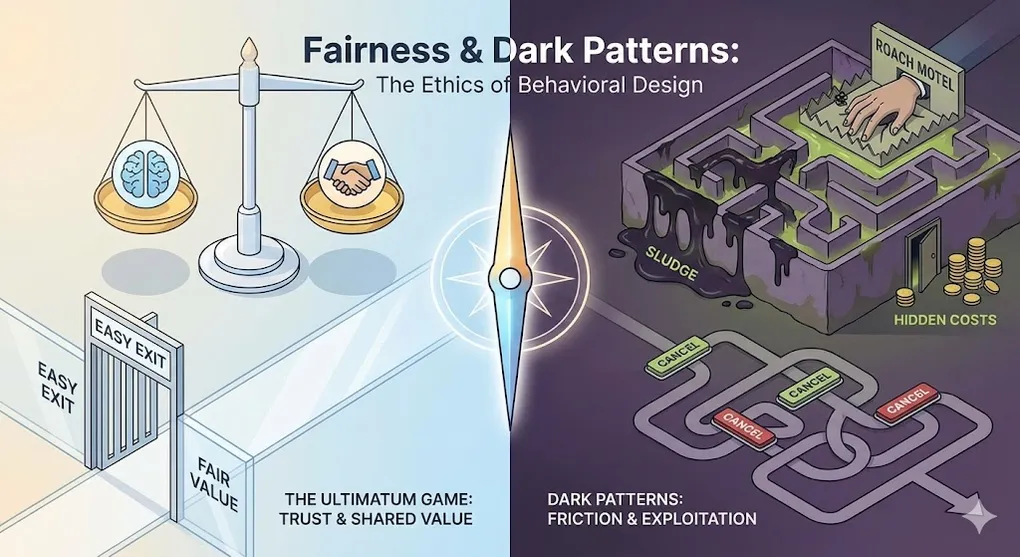
Fairness & Dark Patterns: The Ethics of Behavioral Design
The Moral Dimension of Behavioral Economics
Behavioral economics gives us powerful tools to influence decisions. But with great power comes an important question:
Are we helping users make better choices, or exploiting their cognitive limitations?
This article explores the ethics of behavioral design through two lenses:
- The Ultimatum Game: Why humans care deeply about fairness
- Sludge: When design deliberately creates friction for profit
Part 1: The Ultimatum Game
The Experiment
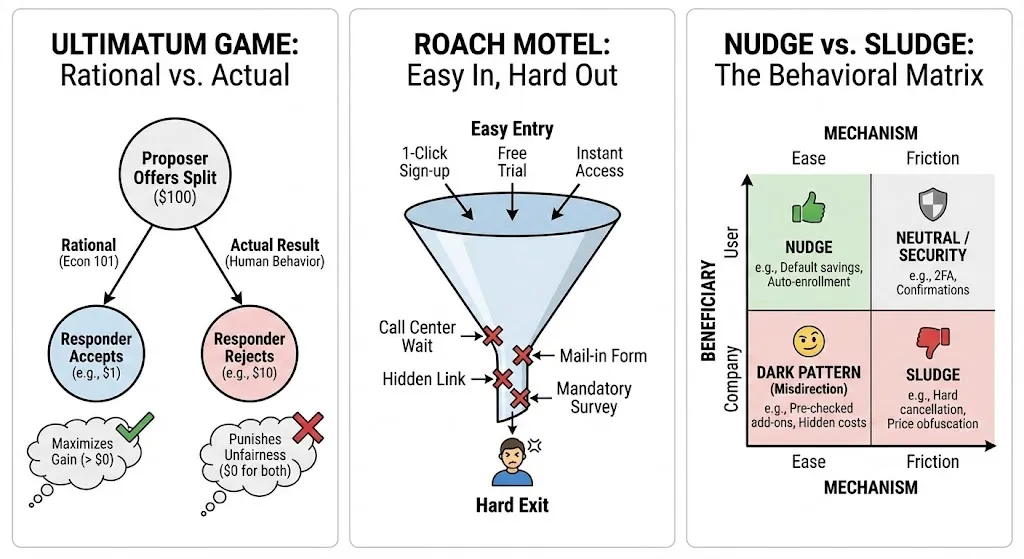
Two players. $100 to split.
| Role | Action |
|---|---|
| Proposer | Decides how to split (e.g., “30 for you”) |
| Responder | Accepts or rejects. If rejected, both get $0. |
Rational Prediction (Traditional Economics)
The Responder should accept any offer above $0.
Logic: Getting 0. A rational agent maximizes utility.
Predicted outcome: Proposer offers $1, Responder accepts.
Actual Results
| Offer | Acceptance Rate |
|---|---|
| 50% ($50) | ~100% |
| 40% ($40) | ~95% |
| 30% ($30) | ~75% |
| 20% ($20) | ~50% |
| 10% ($10) | ~25% |
People reject free money to punish unfairness.
Why Fairness Matters
| Explanation | Mechanism |
|---|---|
| Inequity Aversion | We dislike unequal outcomes, even at personal cost |
| Altruistic Punishment | We punish norm violators, even when it hurts us |
| Reputation Signaling | Rejecting unfair offers signals “don’t try to exploit me” |
| Emotional Response | Unfair offers trigger disgust and anger |
Brain Science
fMRI studies show unfair offers activate the anterior insula—the same region that processes disgust from rotten food.
We literally experience unfairness as disgusting.
Business Implications of Fairness
Pricing Perception
| Scenario | Perception |
|---|---|
| Surge pricing during disaster | Outrage, boycotts |
| Price increase after cost increase | Acceptable |
| Price increase to boost profits | Unfair |
The Dual Entitlement Principle (Kahneman):
- Firms are entitled to their reference profit
- Customers are entitled to their reference price
- Violating either feels unfair
Employee Relations
The Ultimatum Game explains workplace behavior:
| Action | Employee Response |
|---|---|
| Layoffs without severance | Remaining employees reduce effort (punishment) |
| Executive bonuses during cuts | Perceived unfairness → morale crash |
| Transparent, fair process | Acceptance, even of bad outcomes |
Customer Service
| Unfair Treatment | Customer Behavior |
|---|---|
| Hidden fees discovered late | Negative reviews (punishment) |
| Denied refund for valid reason | Social media complaints |
| Acknowledged mistake + fair resolution | Loyalty increases |
Detecting Fairness Sensitivity in Data
def analyze_fairness_response(pricing_df, customer_feedback_df):
    """
    Detect when pricing changes trigger fairness concerns.

    Signals:
    1. Price increase → disproportionate churn
    2. Negative sentiment spikes
    3. Social mentions of "unfair," "rip-off"
    """

    # Merge pricing events with churn
    price_changes = pricing_df[pricing_df['change_type'] == 'increase']

    for idx, change in price_changes.iterrows():
        date = change['date']
        pct_increase = change['percentage']

        # Churn in 30 days after
        churn_after = customer_feedback_df[
            (customer_feedback_df['date'] > date) &
            (customer_feedback_df['date'] <= date + pd.Timedelta(days=30))
        ]['churned'].mean()

        # Baseline churn
        baseline_churn = customer_feedback_df['churned'].mean()

        # Fairness keywords
        fairness_mentions = customer_feedback_df[
            customer_feedback_df['feedback'].str.contains('unfair|rip-off|greedy', case=False)
        ].shape[0]

        print(f"Price increase: {pct_increase:.1f}%")
        print(f"  Churn rate: {churn_after:.1%} (baseline: {baseline_churn:.1%})")
        print(f"  Fairness complaints: {fairness_mentions}")

        if churn_after > baseline_churn * 1.5:
            print("  ⚠️ Fairness backlash detected")

# PRO TIP: For production, use sentiment analysis
# from textblob import TextBlob
# or
# from vaderSentiment.vaderSentiment import SentimentIntensityAnalyzer
#
# def get_sentiment(text):
#     analyzer = SentimentIntensityAnalyzer()
#     score = analyzer.polarity_scores(text)['compound']
#     return 'negative' if score < -0.05 else 'positive' if score > 0.05 else 'neutral'
Part 2: Sludge — The Dark Side of Nudging
What is Sludge?
Sludge is friction intentionally designed to work against the user’s interests.
“Sludge is the evil cousin of nudge.”
— Richard Thaler
| Nudge | Sludge |
|---|---|
| Reduces friction for good choices | Adds friction to discourage actions |
| Helps users | Helps the company at user expense |
| Opt-out from savings = removed | Cancellation = buried in friction |
When Friction is Good
Not all friction is bad. Good friction protects users from irreversible mistakes.
| Good Friction (Protective) | Bad Friction (Sludge) |
|---|---|
| “Are you sure you want to delete your account?“ | 5-page form to delete account |
| Two-factor authentication for large transfers | Phone call required for any change |
| ”Review order” step before payment | Hidden fees revealed at checkout |
| Cooling-off period for major purchases | 30-day wait to cancel trial |
The Litmus Test: Good friction adds a moment of reflection. Sludge adds obstacles to escape. One protects. The other traps.
Common Sludge Patterns
1. Roach Motel
Easy to get in, hard to get out.
| Entry | Exit |
|---|---|
| ”Sign up in 30 seconds" | "Call 1-800 number, wait on hold, speak to retention” |
| One-click subscribe | 5-page cancellation flow with guilt trips |
| Free trial auto-converts | Hidden cancellation buried in settings |
🏛️ FTC Rule (2024): The US Federal Trade Commission’s “Click to Cancel” rule is clear:
“If it takes 1 click to buy, it must take 1 click to cancel.”
Companies face fines for asymmetric friction. This is no longer just bad ethics—it’s illegal.
2. Hidden Costs
| Displayed Price | Actual Price |
|---|---|
| ”$29/month" | "+3 processing +$8 taxes" |
| "From $199” | Only applies to worst configuration |
| ”Free shipping” | On orders over $75 (shown at checkout) |
3. Confirm-Shaming
Guilt-trip language on opt-out buttons:
| Opt-In | Opt-Out (Sludge) |
|---|---|
| “Yes, subscribe" | "No, I don’t want to save money" |
| "Sign up" | "No thanks, I hate good deals" |
| "Get discount" | "I prefer paying full price” |
4. Misdirection
| Dark Pattern | Mechanism |
|---|---|
| Pre-checked boxes | Travel insurance, newsletter, add-ons |
| Disguised ads | ”Download” button that’s actually an ad |
| Trick questions | Double negatives in opt-out |
5. Obstruction
| Goal | Sludge |
|---|---|
| Delete account | Requires email to support (5-day wait) |
| Get refund | Form requires receipt + photo + written explanation |
| Report issue | 10-step phone tree with no human option |
Measuring Sludge in Your Organization
The Sludge Audit
| Step | Analysis |
|---|---|
| 1. Map customer journey | Identify all touchpoints |
| 2. Count friction points | Steps, clicks, wait times |
| 3. Compare IN vs. OUT | Is exit harder than entry? |
| 4. Test yourself | Try to cancel, get refund, change settings |
| 5. Review complaints | What processes frustrate users? |
Sludge Audit Checklist
## Sludge Audit Template

### Subscription/Membership
- [ ] Can users cancel as easily as they signed up?
- [ ] Is cancellation available online (not phone-only)?
- [ ] Are there guilt-trip messages or dark patterns?
- [ ] Is the cancellation link easy to find?

### Pricing
- [ ] Is the final price clear before checkout?
- [ ] Are all fees disclosed upfront?
- [ ] Are there hidden costs revealed only at checkout?

### Data/Privacy
- [ ] Can users delete their data easily?
- [ ] Is opting out of marketing simple?
- [ ] Are privacy settings accessible?

### Refunds/Returns
- [ ] Is the refund process proportional to purchase ease?
- [ ] Are requirements (receipts, forms) reasonable?
- [ ] Is there a human accessible when needed?
Quantifying Sludge Impact
The Sludge Score formula quantifies friction as a weighted sum:
Where:
- Effort = Clicks, form fields, page loads, wait time
- Emotional Cost = Guilt trips, confirm-shaming, misdirection
- w = Weight (higher for more hostile patterns)
def calculate_sludge_score(process_steps, custom_weights=None):
    """
    Calculate a sludge score for a process based on friction points.

    Higher score = More friction (User Hostile).
    """
    # Default weights - customize based on your user base sensitivity
    weights = custom_weights or {
        'clicks': 1,
        'form_fields': 2,
        'page_loads': 3,
        'phone_required': 20,  # High penalty for forcing offline
        'mail_required': 50,   # Extreme penalty for physical mail
        'wait_days': 10,
        'guilt_trip': 5        # Emotional friction
    }

    total_score = 0
    details = []

    for i, step in enumerate(process_steps):
        step_score = 0
        for friction_type, count in step.items():
            if friction_type in weights:
                points = weights[friction_type] * count
                step_score += points

        total_score += step_score
        details.append(f"Step {i+1}: {step_score} pts")

    return total_score, details

# Example: Compare signup vs. cancellation
signup_process = [
    {'clicks': 3, 'form_fields': 4, 'page_loads': 2}
]

cancel_process = [
    {'clicks': 8, 'form_fields': 2, 'page_loads': 5, 'phone_required': 1, 'guilt_trip': 2}
]

signup_score = calculate_sludge_score(signup_process)
cancel_score = calculate_sludge_score(cancel_process)

print(f"Signup Sludge Score: {signup_score}")
print(f"Cancel Sludge Score: {cancel_score}")
print(f"Sludge Ratio: {cancel_score/signup_score:.1f}x")

if cancel_score > signup_score * 2:
    print("⚠️ HIGH SLUDGE: Exit significantly harder than entry")
The Regulatory Response
Sludge is increasingly attracting regulatory attention:
| Jurisdiction | Action |
|---|---|
| EU (GDPR) | Right to erasure, easy consent withdrawal |
| California (CCPA) | Simple opt-out mechanisms required |
| FTC (US) | “Click to Cancel” enforcement actions |
| UK CMA | Dark patterns enforcement |
The Business Case for Fair Design
| Short-term Sludge “Benefit” | Long-term Hidden Cost |
|---|---|
| Lower cancellation rate | Higher CAC (angry customers don’t refer) |
| More accidental purchases | Lower CLTV (betrayed → gone forever) |
| Captured users | Regulatory fines, legal action |
| Met quarterly retention KPI | Brand damage, negative PR |
| Customer support costs spike |
🔥 The Sludge Metaphor: “Sludge is like burning your furniture to heat your house. It works for a night, but then you have nowhere to sit.”
The Counter-Example: Netflix’s Ethical Offboarding
Netflix does something remarkable:
| Netflix Practice | Why It Works |
|---|---|
| One-click cancel | No phone, no guilt trips |
| Pause before cancel | Offers alternatives without manipulation |
| Proactive pause for inactive accounts | ”We noticed you haven’t watched in months. We’ve paused your billing.” |
| Easy resubscribe | ”Welcome back” → one click |
Result: Customers trust Netflix. They cancel without resentment and return when ready. The lifetime value increases because the exit was fair.
Fairness pays off. Netflix’s approach proves that ethical design is not just morally right—it’s strategically smart.
Ethical Framework: Nudge vs. Sludge
The Transparency Test
“Would you be comfortable if your design was explained on the front page of a newspaper?”
| Test | Nudge | Sludge |
|---|---|---|
| Transparency | Works even when disclosed | Requires obscurity |
| User benefit | Helps user achieve their goals | Helps company at user expense |
| Reversibility | Easy to opt out | Difficult to reverse |
| Honesty | No deception | Relies on confusion |
Designing for Trust
| Sludge Approach | Trust-Building Alternative |
|---|---|
| Hide cancellation | Prominent “Cancel” button |
| Guilt-trip copy | ”We’re sorry to see you go” |
| Phone-only cancellation | Self-service online |
| Hidden fees | ”Final price, no surprises” |
| Dark patterns | Honest, clear UX |
Summary
Fairness Principles (Ultimatum Game)
| Insight | Application |
|---|---|
| People punish unfairness | Don’t exploit price inelasticity |
| Process matters | Fair process makes bad outcomes acceptable |
| Transparency builds trust | Explain the “why” behind decisions |
| Reputation signals | Your actions signal your character |
Sludge Red Flags
| Red Flag | What It Indicates |
|---|---|
| Exit harder than entry | Roach motel pattern |
| Hidden costs at checkout | Drip pricing |
| Guilt-trip opt-outs | Confirm-shaming |
| Complex refund process | Obstruction |
| Phone-only for simple tasks | Deliberate friction |
The Ethical Designer’s Commitment
- Audit regularly for unintentional sludge
- Match friction — exit as easy as entry
- Disclose fully — no hidden costs
- Respect autonomy — clear, honest choices
- Consider long-term — trust > short-term traps
Making It Systematic: Sludge Audit in Your Workflow
Don’t let ethics be an afterthought. Integrate Sludge Audit into your QA process:
| Phase | Action |
|---|---|
| Design Review | Run the Transparency Test on all user flows |
| Pre-Launch QA | Compare signup vs. cancellation friction scores |
| Monthly Check | Mystery-shop your own product (try to cancel) |
| Design System | Add “No Sludge” as a documented principle |
Your CTA: Before your next release, calculate the Sludge Ratio. If
cancel_score > signup_score * 2, you have a problem. Fix it before your users—or regulators—find it.
How to Convince Your Boss to Remove Sludge
Most bosses aren’t evil—they’re captured by short-term metrics. When Sludge lowers churn by 20%, it’s tempting.
You can’t just argue ethics. You have to argue money, risk, and efficiency.
Strategy 1: Calculate the Hidden Costs
Bosses see “retained subscriptions.” They don’t see the cost of retaining them.
| What They See | What They Don’t See |
|---|---|
| 500 users “saved” by hard cancellation | 300 support tickets asking “how do I cancel?” |
| $5,000/month retained revenue | $4,500/month support cost handling complaints |
The Math:
- Average support ticket cost: $5–15 USD
- If a user pays $10/month but files one angry ticket, you’re losing money
Talk Track: “We kept 500 users, but we got 300 cancellation-related tickets. At 3,000 in support costs to ‘save’ users who didn’t want to stay.”
Strategy 2: Emphasize Customer Lifetime Value
Sludge burns bridges. This is “burning furniture to heat the house.”
| Exit Experience | Future Behavior |
|---|---|
| Angry departure | Never returns. Tells 10 friends. CAC to re-acquire = ∞ |
| Peaceful goodbye | Returns when needs change. Refers friends. |
Talk Track: “Our CAC is 50 of future acquisition potential. Let them leave happy—they’ll come back.”
Strategy 3: Invoke Regulatory Risk
This is the kill shot. Sludge isn’t just unethical—it’s increasingly illegal.
| Regulation | Requirement |
|---|---|
| FTC “Click to Cancel” (2024) | Cancellation can’t be harder than signup |
| EU GDPR / DMA | Heavy penalties for dark patterns |
| California CCPA | Simple opt-out mechanisms required |
Talk Track: “The FTC just passed ‘Click to Cancel.’ If our cancellation flow is harder than signup, we’re exposed to fines and legal action. This isn’t about ethics—it’s about compliance.”
Strategy 4: Propose Better Alternatives
Don’t just say “remove Sludge.” Offer good friction that retains users ethically:
| Instead of… | Try… |
|---|---|
| Hiding cancel button | Clear button → then offer discount |
| Requiring phone call | Offer pause subscription option |
| Multi-step guilt flow | One-click cancel → downgrade to free tier |
Talk Track: “Instead of hiding the button, what if we show it clearly but offer a 50% discount or a 3-month pause? We keep willing customers, and let unhappy ones leave cleanly. Adobe and Netflix do this.”
Further Reading
- 📄 Thaler, R. (2018). Nudge, not sludge. Science.
- 📖 Misbehaving — Richard Thaler
- 📖 Evil by Design — Chris Nodder
- 🌐 Dark Patterns Hall of Shame — darkpatterns.org
- 📄 FTC Staff Report on Dark Patterns (2022)