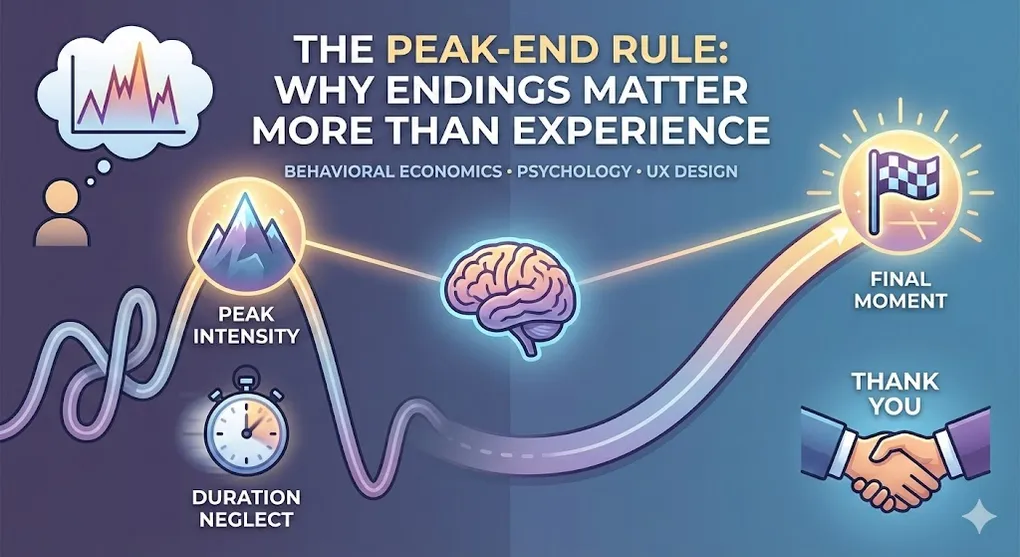
The Peak-End Rule: Why Endings Matter More Than Experience
The Memory Paradox
Imagine two versions of a colonoscopy procedure:
| Version | Duration | Pain Level | Ending |
|---|---|---|---|
| A | 8 minutes | High pain throughout | Ends abruptly at peak pain |
| B | 24 minutes | Same pain + 16 extra minutes of mild discomfort | Ends gradually, low pain |
Which procedure would patients rate as worse?
Counterintuitively: Patients rated Version A as worse, despite Version B having three times the duration and more total pain.
This is the Peak-End Rule—and it fundamentally changes how we should design experiences.
Kahneman’s Cold Water Experiment
Daniel Kahneman demonstrated this phenomenon with a simple experiment:
The Setup
Participants immersed their hand in painfully cold water (14°C) in two trials:
| Trial | Duration | Temperature Profile |
|---|---|---|
| Short Trial | 60 seconds | Constant 14°C |
| Long Trial | 90 seconds | 60s at 14°C, then 30s gradually warming to 15°C |
The Surprising Result
When asked which trial they’d repeat, 80% chose the Long Trial—even though it had:
- More total pain (30 extra seconds)
- More cold exposure
- Longer duration
Why? The ending was slightly less painful.
The Peak-End Rule Explained
Definition: Our evaluation of a past experience is dominated by two moments: the peak (most intense point) and the end (final moment).
What Our Brains Ignore
| Factor | Weight in Memory |
|---|---|
| Peak intensity | High |
| Final moment | High |
| Total duration | Almost zero (Duration Neglect) |
| Average experience | Low |
The Implications
This means:
- A 2-week vacation isn’t remembered as “better” than a 1-week vacation
- A 3-hour movie isn’t rated higher than a 90-minute one (if peaks/ends equal)
- A painful process with a gentle ending is remembered more favorably
Duration Neglect: Time Is (Almost) Irrelevant
Duration Neglect is the companion finding: we barely factor duration into our evaluations.
Example: Vacation Memories
| Vacation A | Vacation B |
|---|---|
| 1 week | 2 weeks |
| Amazing peak moment (snorkeling) | Same amazing moment |
| Relaxing final day | Rushed airport ending |
Remembered as: Vacation A was better.
Despite B having:
- Twice the duration
- More total enjoyable moments
- Same peak experience
The rushed ending of B dominates the memory.
Business Applications: Designing for Memory
The IKEA Model
IKEA’s experience seems designed to torture customers:
- Maze-like layout (no shortcuts)
- Exhausting walk through entire store
- Self-service warehouse
- DIY furniture assembly
Yet customers love IKEA. Why?
| Pain Point | Peak-End Strategy |
|---|---|
| Long walk | Peak: Surprisingly cheap items discovered (“Only $5!”) |
| Exhaustion | Peak: Inspiring showrooms mid-journey |
| Checkout frustration | End: 1 hot dog & 0.50 soft-serve ice cream |
The final memory: “Great deals, delicious cheap food.”
Disney’s Approach
Disney designs experiences with explicit peak-end management:
| Element | Purpose |
|---|---|
| Castle at center | Create anticipation (sets up peak) |
| Fireworks at closing | Guarantee powerful ending |
| Character meet at exit | Sweet final interaction |
| ”Have a magical day!” | Verbal ending ritual |
Apple Store Experience
| Moment | Design Choice |
|---|---|
| Entry | Open, inviting, no pressure |
| Peak | Hands-on product trial (emotional high) |
| End | Genius Bar resolution or purchase celebration |
| Exit | Staff says goodbye by name |
Apple invests heavily in the leaving experience, not just the buying.
Service Design Framework
The Peak-End Design Process
1. Map the customer journey
2. Identify potential peak moments (positive or negative)
3. Amplify positive peaks
4. Mitigate negative peaks
5. Engineer a strong positive ending
6. Don't worry about duration (within reason)
Creating Peaks Through Surprise
Peaks don’t just happen—they’re engineered. The most reliable way to create a peak is through unexpected positive experiences:
| Strategy | Example |
|---|---|
| Unexpected upgrade | Airlines upgrading to business class |
| Hidden delights | Mailchimp’s high-five animation after sending |
| Over-delivery | Amazon arriving a day early |
| Personal touch | Handwritten thank-you note in package |
| Celebration moments | Duolingo’s streak celebrations |
The Surprise Formula: Peak = Expectation Gap × Emotional Intensity
The bigger the positive gap between what was expected and what was delivered, the stronger the peak.
Practical Checklist
| Question | Action |
|---|---|
| Where is the emotional high point? | Amplify it—make it memorable |
| Where can we exceed expectations? | Add a surprise moment |
| Where is the pain point? | Either fix it or ensure it’s not the ending |
| How does the experience end? | Design a positive closing ritual |
| Are you optimizing the middle? | Stop. Invest in peaks and ends instead. |
Medical Applications
The colonoscopy study led to actual changes in medical procedure:
Before (Traditional)
- Procedure ends immediately when complete
- Last moment = peak discomfort
After (Peak-End Optimized)
- Extra minute of scope stationary (less painful)
- Last moment = reduced discomfort
- Patients more likely to return for follow-ups
Impact: Potentially life-saving, as patients are more willing to undergo preventive screenings.
Digital Product Design
Onboarding Flows
| Poor Design | Peak-End Optimized |
|---|---|
| Ends with “Setup complete” | Ends with accomplishment (“You just created your first X!”) |
| Long form, same intensity | Front-load hard parts, end with easy wins |
| No memorable moment | Include a “wow” moment mid-flow |
Error Handling
| Poor Design | Peak-End Optimized |
|---|---|
| Generic error message | Recovery + small positive (discount code) |
| Session ends on error | Graceful save + friendly message |
| User left frustrated | Transform negative peak into resolution story |
Subscription Cancellation
| Poor Design | Peak-End Optimized |
|---|---|
| Guilt trip, friction | Easy process, genuine thank you |
| Ends with “You’re unsubscribed" | "We’ll miss you. Here’s a gift for when you return.” |
| Burns the bridge | Leaves door open positively |
Detecting Peak-End Effects in Data
import pandas as pd
import numpy as np

def analyze_journey_peaks(session_df, retention_df=None):
    """
    Analyze customer journey for peak-end effects.

    Expects columns:
    - session_id: unique session identifier
    - timestamp: event time
    - satisfaction_score: momentary satisfaction (1-10)

    Optional: retention_df with session_id and returned (bool)
    """

    results = []

    for session_id, group in session_df.groupby('session_id'):
        group = group.sort_values('timestamp')

        # Calculate metrics
        peak_score = group['satisfaction_score'].max()
        end_score = group['satisfaction_score'].iloc[-1]
        avg_score = group['satisfaction_score'].mean()
        duration = len(group)

        # Peak-End prediction
        peak_end_prediction = (peak_score + end_score) / 2

        results.append({
            'session_id': session_id,
            'peak': peak_score,
            'end': end_score,
            'average': avg_score,
            'duration': duration,
            'peak_end_score': peak_end_prediction
        })

    results_df = pd.DataFrame(results)

    # If we have retention data, this is the key test:
    # Does Peak-End Score predict FUTURE BEHAVIOR better than Average?
    if retention_df is not None:
        results_df = results_df.merge(retention_df, on='session_id')
        print("Correlation with FUTURE RETENTION (the real test):")
        print(f"  Peak-End Score ↔ Retention: {results_df['peak_end_score'].corr(results_df['returned']):.3f}")
        print(f"  Average Score ↔ Retention:  {results_df['average'].corr(results_df['returned']):.3f}")
        print(f"  Duration ↔ Retention:       {results_df['duration'].corr(results_df['returned']):.3f}")
    else:
        # Fallback: correlate with average (less meaningful)
        print("Correlation analysis (connect to retention/NPS for real insights):")
        print(f"  Peak-End Score: {results_df['peak_end_score'].corr(results_df['average']):.3f}")
        print(f"  Duration:       {results_df['duration'].corr(results_df['average']):.3f}")

    return results_df
What to Measure
| Metric | What It Reveals |
|---|---|
| Peak moment identification | Which touchpoint drives memory |
| End moment score | How journey closes |
| Peak-End vs. Average correlation | Which better predicts retention |
| Duration vs. satisfaction | Likely weak correlation |
The Two Selves: Experiencing vs. Remembering
Kahneman distinguishes between two selves:
| Self | Focus | Question It Answers |
|---|---|---|
| Experiencing Self | Moment-to-moment feelings | ”How do you feel right now?” |
| Remembering Self | Retrospective evaluation | ”How was your vacation?” |
The Conflict
| Experiencing Self | Remembering Self |
|---|---|
| Cares about total duration | Ignores duration |
| Values every moment equally | Values peaks and ends |
| Lives in the present | Creates the narrative |
Which Self Matters for Business?
Usually the Remembering Self, because:
- Word-of-mouth recommendations come from memory
- Repeat purchases are based on remembered experience
- Ratings and reviews reflect remembered, not experienced, satisfaction
The Psychology of the “End”
“A bad ending can ruin a great movie, but a great ending can save a mediocre one.”
The ending has disproportionate power because it’s what we carry forward:
| Experience | Ending | Memory |
|---|---|---|
| Perfect date, argument at the end | 😡 | “It was a disaster” |
| Mediocre date, sweet goodbye | 😊 | “It was nice” |
| Great vacation, lost luggage on return | 😤 | “Never flying with them again” |
| Average vacation, surprise upgrade home | ✈️ | ”What a trip!” |
The Final Moment Checklist
- ✅ Is the last touchpoint positive?
- ✅ Does it leave them wanting more?
- ✅ Is there a clear “closing ritual”?
- ❌ Does it end on administrative tasks? (Bad)
- ❌ Does it end with payment? (Move payment earlier)
Summary
| Concept | Implication |
|---|---|
| Peak-End Rule | |
| Duration Neglect | Length barely matters within reason |
| Experiencing vs. Remembering | Design for the remembering self |
| Surprise = Peaks | Exceed expectations strategically |
| Endings are Fragile | A bad ending can erase everything |
⚠️ Caveat on Duration Neglect: While duration is almost irrelevant, there’s a threshold. Disney’s fireworks can’t save a 5-hour queue. If duration crosses into “unreasonable” territory, no ending can rescue the experience. The rule works best within “acceptable” duration ranges.
Design Principles
- Create at least one memorable peak (through surprise)
- Never end on a low note (endings are fragile)
- Don’t obsess over duration (but stay within reason)
- Front-load pain, back-load pleasure
- Design closing rituals
Further Reading
- 📄 Kahneman, D. (2000). Evaluation by Moments: Past and Future. In Choices, Values and Frames.
- 📖 The Power of Moments — Chip & Dan Heath
- 📖 Thinking, Fast and Slow — Daniel Kahneman (Chapter on Two Selves)