Norms & Self-Regulation: Social Exchange, Moral Licensing, and Decision Modes
The Hidden Rules of Human Behavior
Traditional economics assumes people respond predictably to incentives: pay more, get more effort. But human motivation is far more complex.
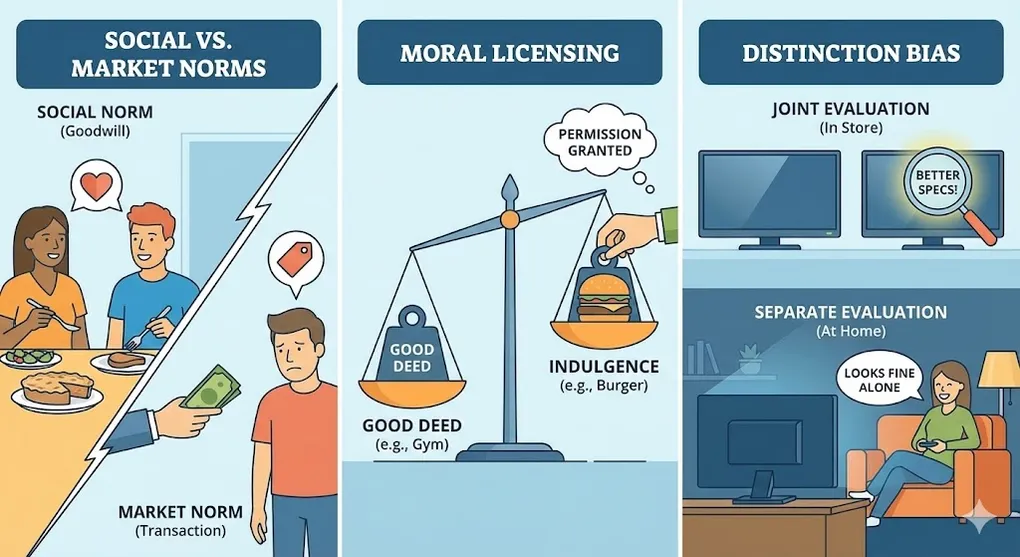
This article explores three phenomena that reveal the subtle rules governing our behavior:
- Social vs. Market Norms: When money destroys motivation
- Moral Licensing: When good deeds enable bad ones
- Distinction Bias: When comparison distorts judgment
Part 1: Social Norms vs. Market Norms
The Two Parallel Worlds
We operate under two different sets of rules, often without realizing it:
| Social Norms | Market Norms |
|---|---|
| Based on relationships | Based on transactions |
| Reciprocity & goodwill | Payment & contracts |
| Favors, not fees | Prices, not gifts |
| ”Happy to help" | "What’s my rate?” |
The Critical Rule
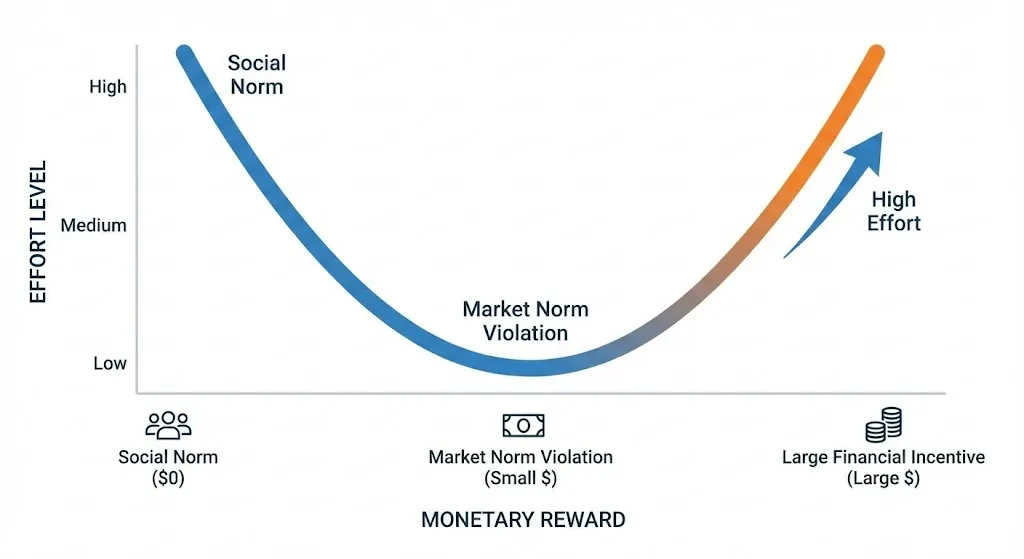
Never mix them. Introducing market norms into a social context destroys the social relationship—often permanently.
The Lawyer Experiment
Researchers asked lawyers to provide services:
| Request | Response |
|---|---|
| ”Would you offer discounted services ($30/hr) for retirees?“ | 68% said no |
| ”Would you offer FREE services for retirees?” | Majority said yes |
The paradox: Offering less money got less help than offering no money.
Why This Happens
| $0 (Social Norm) | $30 (Market Norm) |
|---|---|
| “This is charity" | "This is work” |
| Pro bono = prestigious | $30/hr = insulting |
| Identity: generous helper | Identity: cheap labor |
The Mother-in-Law Problem
Your mother-in-law cooks an elaborate dinner for the family.
| Response | Effect |
|---|---|
| ”Thank you, it was delicious!” | Social norm preserved ✅ |
| “Here’s $200 for your trouble” | Social norm destroyed ❌ |
Money converts a gift into a transaction—and implies the relationship is transactional.
Business Implications
Employee Motivation
| Approach | Effect |
|---|---|
| Pure market: High salary, clear metrics | Transactional loyalty |
| Pure social: Mission, culture, belonging | Emotional loyalty |
| Mixed (dangerous): Mission + tiny bonus | Destroys intrinsic motivation |
Key insight: A small bonus can be worse than no bonus. It signals “your extra effort is worth $20” and kills the social motivation.
Customer Relationships
| Social Frame | Market Frame |
|---|---|
| ”We appreciate your loyalty" | "10% loyalty discount” |
| Birthday card | Birthday coupon |
| Community membership | Rewards program |
Caution: Once you’ve established a social relationship, introducing market terms can backfire.
The Fine for Late Pickup
A famous study at daycare centers:
| Phase | Policy | Late Pickups |
|---|---|---|
| Before | Social norm (guilt) | Low |
| During | $3 fine for lateness | Doubled |
| After | Fine removed | Stayed high |
The $3 fine converted guilt into a transaction. Parents thought: “I’m paying for the service of being late.” When the fine was removed, the social norm didn’t return—it had been destroyed.
Part 2: Moral Licensing
The Psychology of Permission
Moral Licensing: After doing something “good,” we feel we’ve earned permission to do something “bad.”
It’s as if we have a moral bank account:
- Good deed → Deposit
- Indulgence → Withdrawal
Classic Examples
| Good Deed | Licensed Indulgence |
|---|---|
| Morning gym session | ”I deserve this burger” |
| Donated to charity | Less likely to help next request |
| Bought organic | ”I can drive instead of walk” |
| Hired diverse candidate | Less scrutiny in next hire |
The Salad-Then-Fries Effect
Research on menu ordering:
| Menu Type | Order Behavior |
|---|---|
| Healthy options available | More likely to order unhealthy |
| Only unhealthy options | More deliberate about indulgence |
Just seeing the healthy option (even without ordering it) provided moral license.
The Energy Paradox
| Action | Unintended Consequence |
|---|---|
| Bought energy-efficient appliances | Increased usage (felt “permitted”) |
| Got hybrid car | Drove more miles |
| LED lightbulbs | Left lights on longer |
Result: Many “green” purchases have smaller environmental impact than expected due to behavioral rebound.
Self-Licensing Dynamics
Good Deed
    ↓
Moral Credit Perception
    ↓
Reduced Guilt for Indulgence
    ↓
Increased "Bad" Behavior
Counteracting Moral Licensing
| Strategy | Mechanism |
|---|---|
| Commitment identity | ”I’m a healthy person” vs. “I did a healthy thing” |
| Goals, not achievements | Focus on ongoing journey, not completed tasks |
| Remove licensing opportunities | Don’t celebrate too early |
| Awareness | Simply knowing about the effect reduces it |
Part 3: Distinction Bias
The TV Store Problem
You’re choosing between two TVs:
| Condition | Your Experience |
|---|---|
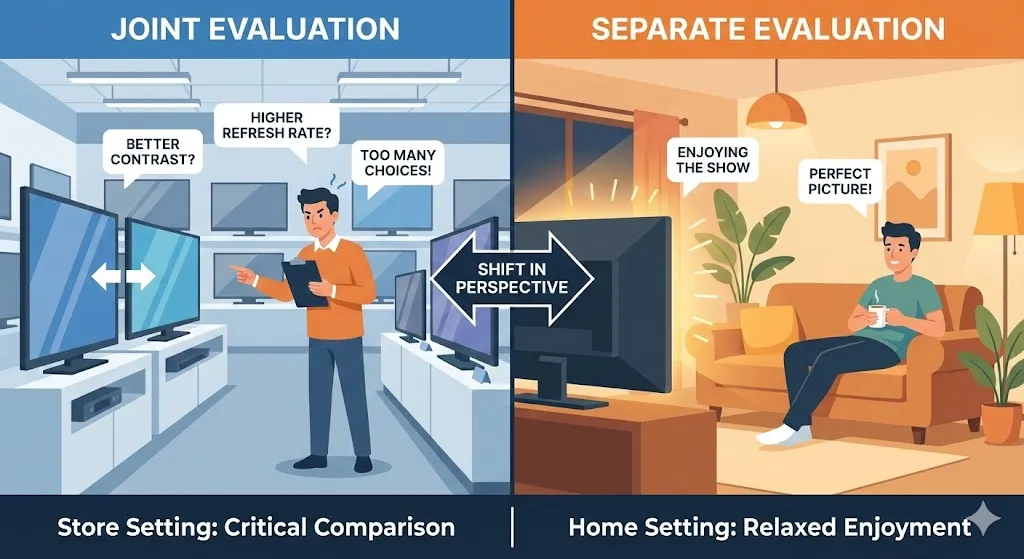
| In store (side-by-side) | “TV A is clearly brighter! Worth the $500 extra” |
| At home (alone) | “Looks fine. Was the extra $500 worth it?” |
Joint vs. Separate Evaluation
| Evaluation Mode | What We Notice |
|---|---|
| Joint (comparing) | Every tiny difference magnified |
| Separate (alone) | Only major features matter |
The Problem
We make decisions in Joint mode (store) but experience outcomes in Separate mode (home).
This leads to systematic over-weighting of distinguishing features.
Real-World Examples
| Decision Context | Experience Context | Overpaid For |
|---|---|---|
| Job offers side-by-side | One job at a time | Salary differences |
| Apartments toured same day | Living in one apartment | Minor finishes |
| Phones compared in store | Using one phone | Spec differences |
The Ice Cream Study
Participants evaluated ice cream:
| Serving | Amount | Appearance | Evaluation |
|---|---|---|---|
| Small cup, overflowing | 7 oz | Full, generous | Higher rating |
| Large cup, half-empty | 8 oz | Sparse, stingy | Lower rating |
Alone (separate evaluation): Less ice cream was rated higher because it looked better.
Together (joint evaluation): People correctly saw 8 oz > 7 oz.
Implications for Business
When You’re The Premium Option
Use joint evaluation:
- Show side-by-side comparisons
- Highlight differentiating features
- Create comparison charts
When You’re The Budget Option
Use separate evaluation:
- Present standalone
- Focus on absolute value, not comparison
- Remove competitors from view
Detecting Distinction Bias in Decisions
| Sign | Interpretation |
|---|---|
| Fixation on small spec differences | Joint evaluation distortion |
| ”It seemed important at the time” | Feature irrelevant in use |
| Buyer’s remorse on upgrades | Overpaid for distinguishing features |
Integrating the Concepts
Case Study: Subscription Pricing
| Challenge | Behavioral Insight | Solution |
|---|---|---|
| Users cancel easily | Social norms not engaged | Build community, not just product |
| Users downgrade after trial | Moral licensing from signing up | Delay feature unlocks |
| Users compare to cheaper alternatives | Joint evaluation unfavorable | Emphasize qualitative differences |
The Motivation Matrix
| If You Want… | Avoid… | Instead… |
|---|---|---|
| Extra effort | Tiny bonus | Recognition or real incentive |
| Sustained good behavior | Celebrating achievements | Focus on identity |
| Premium pricing | Feature comparison | Experience framing |
| Long-term loyalty | Transactional rewards | Relationship building |
Detecting These Effects in Data
def analyze_norm_violations(user_df, event_df):
    """
    Detect when market-norm introductions damage engagement.

    Look for:
    1. Engagement drop after small incentive introduction
    2. Decreased pro-social behavior after monetization
    """

    results = {}

    # Find when incentives were introduced
    incentive_events = event_df[event_df['type'] == 'incentive_introduced']

    for idx, event in incentive_events.iterrows():
        date = event['date']
        incentive_size = event['amount']

        # Compare behavior before/after
        before = user_df[user_df['date'] < date]['engagement_score'].mean()
        after = user_df[(user_df['date'] >= date) &
                       (user_df['date'] < date + pd.Timedelta(days=30))]['engagement_score'].mean()

        change = (after - before) / before

        print(f"Incentive: ${incentive_size}")
        print(f"  Engagement before: {before:.2f}")
        print(f"  Engagement after: {after:.2f}")
        print(f"  Change: {change:+.1%}")

        # ⚠️ IMPORTANT: The $20 threshold is illustrative and MUST be calibrated
        # to your specific business context:
        # - Consumer apps: $5-20 might trigger norm violation
        # - B2B SaaS: $100 could still feel "insulting" for enterprise clients
        # - Premium consulting: Even $200 may violate social norms
        #
        # Rule of thumb: If the incentive is < 10% of what the effort would
        # command at market rate, you're likely in the "danger zone."
        if incentive_size < 20 and change < -0.1:
            print("  ⚠️ Small incentive may have violated social norms")

        results[date] = {
            'incentive': incentive_size,
            'before': before,
            'after': after,
            'change': change
        }

    return results


def detect_moral_licensing(behavior_df):
    """
    Detect moral licensing patterns.

    Look for: Good behavior followed by indulgent behavior
    """

    # Sort by user and time
    behavior_df = behavior_df.sort_values(['user_id', 'timestamp'])

    # Flag "good" and "indulgent" behaviors
    good_behaviors = behavior_df[behavior_df['behavior_type'] == 'virtuous']

    licensing_count = 0
    total_good = len(good_behaviors)

    for idx, good in good_behaviors.iterrows():
        # Check next behavior from same user
        next_behaviors = behavior_df[
            (behavior_df['user_id'] == good['user_id']) &
            (behavior_df['timestamp'] > good['timestamp'])
        ].head(1)

        if len(next_behaviors) > 0:
            if next_behaviors.iloc[0]['behavior_type'] == 'indulgent':
                licensing_count += 1

    licensing_rate = licensing_count / total_good if total_good > 0 else 0

    print(f"Moral Licensing Detection:")
    print(f"  Good behaviors followed by indulgence: {licensing_rate:.1%}")

    if licensing_rate > 0.3:
        print("  ⚠️ High licensing rate - consider restructuring rewards")

    return licensing_rate
Summary
| Concept | Key Insight | Application |
|---|---|---|
| Social vs. Market Norms | Money can destroy motivation | Choose your frame carefully; don’t mix |
| Moral Licensing | Good deeds enable bad ones | Focus on identity, not achievements |
| Distinction Bias | Comparison distorts judgment | Control evaluation context |
Design Principles
- Respect the norm type — Don’t introduce money into social contexts
- Small incentives can backfire — Either go big or go social
- Celebrate identity, not actions — “You’re a healthy person” vs. “You exercised”
- Control comparisons — Present premium alone, budget separately
- Match decision context to experience context — Reduce distinction bias
Further Reading
- 📖 Predictably Irrational — Dan Ariely (Chapter on Social vs. Market Norms)
- 📄 Gneezy & Rustichini (2000). A Fine is a Price. Journal of Legal Studies.
- 📄 Sachdeva, Iliev & Medin (2009). Sinning Saints and Saintly Sinners. Psychological Science.
- 📄 Hsee & Zhang (2010). General Evaluability Theory. Perspectives on Psychological Science.