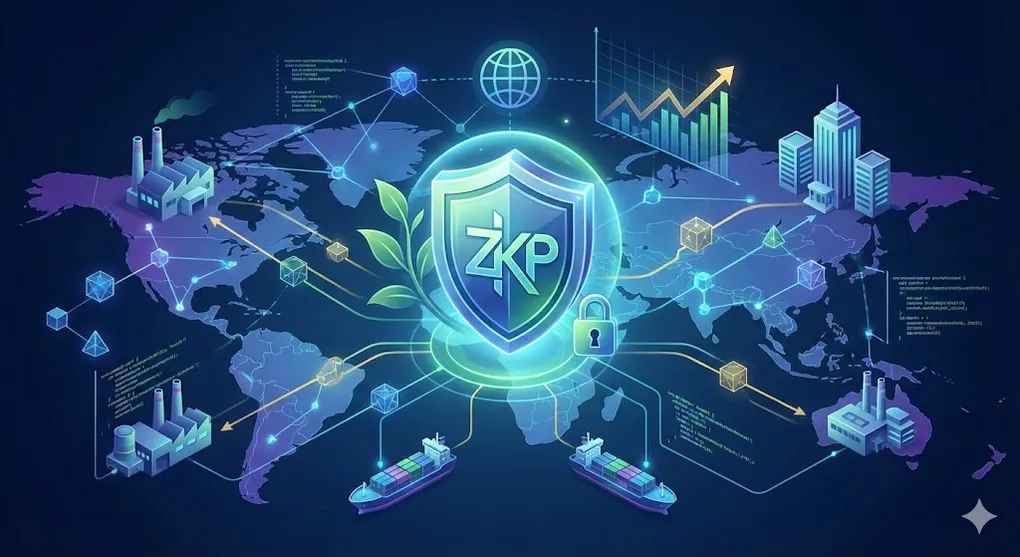
Zero-Knowledge Proofs and ESG: How Web3 Solves the Scope 3 Trust Deadlock
Executive Summary (For C-Suite)
If you only have 2 minutes, here’s what matters:
-
The Problem: Your Scope 3 emissions data is unreliable because suppliers won’t share real numbers—they fear you’ll bypass them and source directly from their vendors.
-
The Solution: Zero-Knowledge Proofs (ZKPs) let suppliers prove “we’re compliant” without revealing any sensitive business data. It’s mathematically impossible for you to extract trade secrets from the proof.
-
The Business Case: Early adopters can unlock 0.3-0.5% lower financing costs (“greenium”), faster CBAM compliance, and competitive advantage in ESG-conscious supply chains. A 500K-$1.5M annually in financing costs alone.
Navigate This Article By Role
| If You Are… | Start Here |
|---|---|
| CEO/CFO | Executive Summary → Part 3.5 (ROI) → Part 4 (Regulatory) |
| Sustainability/ESG | Part 2 (Case Studies) → Part 3 (Re-Fi) → Scope 3 Categories |
| IT/Data Engineering | Part 1.5 (Technical) → Part 1.7 (Privacy Tech Comparison) |
| Procurement | Part 2 (Battery Passport) → Part 3.5 (Scope 3 Categories) |
| Legal/Compliance | Part 4.1 (Regulatory) → Part 4.3 (Auditor Perspective) |
The Scope 3 Deadlock: A Trust Paradox
Companies collecting Scope 3 emissions data face an impossible dilemma:
| Stakeholder | What They Want | Why |
|---|---|---|
| Brand (Buyer) | Complete transparency—trace cotton to the exact farm | ISSB/CSRD compliance, consumer trust |
| Supplier (Seller) | Maximum secrecy—protect upstream sources | Fear of disintermediation (brand bypasses them to source directly) |
Current Solutions Fall Short:
| Approach | Problem |
|---|---|
| Sign NDAs for each data request | Expensive, slow, doesn’t scale to thousands of suppliers |
| Third-party audits | Still depends on human trust; audit reports can be falsified |
| Self-reported questionnaires | ”Garbage in, garbage out”—unverifiable claims |
The Core Problem: All current solutions ultimately rely on trusting people. What if we could verify data mathematically, without trust?
Part 1: What Is Zero-Knowledge Proof? (Plain English Version)
Core Concept: Prove “I know something” or “something is true” without revealing what that something is.
The Bar Bouncer Analogy
| Traditional Verification | ZKP Verification |
|---|---|
| Show ID to bouncer | Machine scans your face |
| Bouncer sees: name, address, exact birthday | Machine returns: Pass or Fail |
| You’ve leaked personal data | Bouncer is certain you’re 18+, but knows nothing else |
The Ali Baba Cave (Classic Cryptography Story)
Imagine a cave with a magic door. You want to prove you know the secret password—but without saying the password out loud.
        ┌─────────────────────────────────────────┐
        │              THE CAVE                   │
        │                                         │
        │    A ←───┐         ┌───→ B              │
        │          │  DOOR   │                    │
        │          └────┬────┘                    │
        │               │                         │
        │          ENTRANCE                       │
        └─────────────────────────────────────────┘

1. Prover enters cave, randomly picks path A or B
2. Verifier waits outside, then shouts "Come out via path A!" (or B)
3. If Prover knows the password, they can always comply
4. Repeat 20 times → 99.9999% certainty Prover knows the secret
5. Verifier never learns the password
The Color-Blind Friend & Two Balls (Intuitive Proof)
For an even more intuitive understanding of ZKP’s interactive logic:
Setup: Your friend is color-blind. They hold two balls (one red, one green) that look identical to them (both gray). You claim the balls are different colors.
Challenge: How do you prove “these balls are different” WITHOUT telling them which is red and which is green?
sequenceDiagram
    participant Friend as Color-Blind Friend<br/>(Verifier)
    participant You as You<br/>(Prover)

    Note over Friend,You: Round 1
    Friend->>Friend: Hide balls behind back
    Friend->>Friend: Randomly swap (or not)
    Friend->>You: "Did I swap them?"
    You->>Friend: "Yes, you swapped" ✓

    Note over Friend,You: Round 2
    Friend->>Friend: Hide balls behind back
    Friend->>Friend: Randomly swap (or not)
    Friend->>You: "Did I swap them?"
    You->>Friend: "No swap" ✓

    Note over Friend,You: After 20 rounds...
    Note over Friend: Probability you're guessing:<br/>1/1,048,576 (≈0.0001%)
    Note over Friend: Friend is CERTAIN balls are different<br/>but still doesn't know which is red!
Business Translation:
- Friend (Brand): Wants to verify supplier is compliant, but can’t see underlying data
- You (Supplier): Have the data (see colors), but won’t reveal details (which is red/green)
- Swapping balls = Cryptographic challenges: Through mathematical verification, prove “I have data AND it’s compliant” without surrendering the data itself
When Procurement Meets Trade Secrets: A Dialogue
Without ZKP — The Traditional Impasse:
| Speaker | Dialogue |
|---|---|
| Brand CPO | ”Mr. Li, our ESG report needs precise Scope 3 data. Please provide your upstream organic cotton farm invoices, farm names, and their carbon calculations. We need 100% transparency.” |
| Supplier | ”Ms. Wang, that’s… difficult. Those organic farms took me five years to secure as exclusive sources. If I hand over contacts and prices, next year you’ll bypass me and source directly. What will I eat then?” |
| Brand CPO | ”We won’t do that. We can sign an NDA.” |
| Supplier | (Thinking: NDA won’t stop your procurement team when someone leaves…) “Really can’t. This is trade secret. But I guarantee the cotton is organic.” |
| Brand CPO | ”Guarantees aren’t enough—EU auditors are strict. No data means you’re a high-risk supplier. Orders may be reduced.” |
| Result | Lose-Lose: Brand gets no verifiable data. Supplier risks losing orders. |
With ZKP — The New Conversation:
| Speaker | Dialogue |
|---|---|
| Supplier | ”Ms. Wang, let’s use the new blockchain system. I’ll upload farm data and generate a ZKP proof for you.” |
| Brand CPO | ”Will I see the farm names?” |
| Supplier | ”You won’t see farm names or my purchase prices. But the system will verify: ✅ Source is from GOTS-certified farms, ✅ Carbon factor is below your 1.5 kg CO2e requirement. You’ll see a green ‘Verified’ light. If I’m lying, the math won’t compute—red light.” |
| Brand CPO | ”So I don’t need to know which farm, but I can prove to EU that sources meet standards?” |
| Supplier | ”Exactly. You get compliance. I keep privacy.” |
| Result | Win-Win: Trust shifts from “believing people” to “believing mathematics.” |
The Enterprise Translation
Supplier proves: “My product’s carbon footprint is below EU threshold”
Without revealing: Bill of Materials (BOM), procurement invoices, upstream supplier names
Part 1.5: ZKP Technical Deep Dive
zk-SNARKs vs zk-STARKs: The Two Families
| Aspect | zk-SNARKs | zk-STARKs |
|---|---|---|
| Full Name | Zero-Knowledge Succinct Non-Interactive Argument of Knowledge | Zero-Knowledge Scalable Transparent Argument of Knowledge |
| Proof Size | Very small (~200 bytes) | Larger (~50-100 KB) |
| Verification Speed | Faster | Slower |
| Trusted Setup | ⚠️ Required (security risk if compromised) | ✅ Not required |
| Quantum Resistance | ❌ Vulnerable | ✅ Resistant |
| Computational Cost | Lower | Higher |
| Used By | Zcash, Tornado Cash | StarkNet, Polygon Miden |
ESG Implication: For supply chain applications where long-term data integrity matters, zk-STARKs may be preferred despite higher costs—because there’s no “trusted setup ceremony” that could be compromised years later.
The Proof Generation Process
┌─────────────────────────────────────────────────────────────────────────┐
│                     ZKP GENERATION WORKFLOW                             │
│                                                                         │
│  ┌─────────────────┐  ┌─────────────────┐  ┌─────────────────┐         │
│  │  Input Data     │→ │  Circuit        │→ │  Proof          │         │
│  │  (Private)      │  │  (Public logic) │  │  (Public)       │         │
│  │                 │  │                 │  │                 │         │
│  │ • BOM details   │  │ • "Sum of all   │  │ • 200 bytes     │         │
│  │ • Invoices      │  │   component     │  │ • Verifiable    │         │
│  │ • Supplier IDs  │  │   emissions     │  │   by anyone     │         │
│  │                 │  │   < 100 kg"     │  │ • Reveals       │         │
│  │ NEVER LEAVES    │  │                 │  │   NOTHING       │         │
│  │ SUPPLIER'S      │  │ SHARED WITH     │  │   about input   │         │
│  │ SYSTEM          │  │ VERIFIER        │  │                 │         │
│  └─────────────────┘  └─────────────────┘  └─────────────────┘         │
└─────────────────────────────────────────────────────────────────────────┘
Compute Cost Breakdown
How expensive is generating a ZKP?
| Operation | AWS Cost (2024) | AWS Cost (2026 Projected) |
|---|---|---|
| Simple proof (age verification) | $0.001 | $0.0001 |
| Medium proof (carbon calculation) | 2.00 | 0.20 |
| Complex proof (full supply chain) | 50 | 5 |
Hardware Requirements:
- RAM: 16-64 GB for medium complexity proofs
- CPU/GPU: High-end processors or specialized ZK hardware (emerging)
- Time: Minutes to hours depending on circuit complexity
Cost Trajectory: ZKP generation costs are dropping approximately 10x every 2 years due to algorithmic improvements and hardware optimization.
Part 1.6: The Oracle Problem — ZKP’s Achilles Heel
What ZKP Can and Cannot Do
| ZKP Can Verify | ZKP Cannot Verify |
|---|---|
| ”This calculation is correct" | "This input data is true" |
| "The numbers add up to the claimed total" | "The factory actually used this much electricity" |
| "The proof was generated from valid inputs" | "The electricity meter wasn’t tampered with” |
The Trust Gap:
Real World           Digital World           Verification
    │                      │                       │
    │   ┌─────────────┐    │    ┌─────────────┐   │
    │   │  Physical   │────┼───→│   Oracle    │───┼───→ ZKP
    │   │  Measurement│    │    │   (Bridge)  │   │
    │   └─────────────┘    │    └─────────────┘   │
    │         ↑            │          ↑           │
    │    Tamperable        │    Still requires    │
    │                      │    trust in oracle   │
Solutions to the Oracle Problem
| Approach | Description | Maturity |
|---|---|---|
| Hardware Attestation | Tamper-proof IoT sensors that cryptographically sign readings at the hardware level | Emerging |
| Multi-Oracle Consensus | Multiple independent data sources must agree before proof generation | Available |
| Reputation Staking | Oracles stake tokens that are slashed if data is proven false | DeFi native |
| Physical Audits + ZKP | Auditors verify physical reality; ZKP handles data privacy | Hybrid (most practical today) |
The Future: IoT + ZKP Integration
The ultimate solution isn’t just software—it’s hardware that can cryptographically attest to physical reality.
flowchart LR
    subgraph "Today: Manual Data Entry"
        A1[Factory Meter] -->|Worker reads| B1[Excel]
        B1 -->|Upload| C1[ZKP System]
        C1 -->|Proof| D1[Blockchain]
    end

    subgraph "Future: Hardware Attestation"
        A2[Smart Meter<br/>with TEE chip] -->|Signed reading| C2[ZKP System]
        C2 -->|Proof + HW signature| D2[Blockchain]
    end

    style A1 fill:#ff6b6b
    style A2 fill:#51cf66
    style B1 fill:#ff6b6b
Emerging Technologies:
| Technology | What It Does | Who’s Building It |
|---|---|---|
| Trusted Execution Environment (TEE) | Secure enclave in chips that signs data before it can be tampered | Intel SGX, ARM TrustZone |
| Hardware Security Module (HSM) | Physically tamper-resistant key storage | Thales, Gemalto |
| ZK-enabled IoT | Sensors that generate ZKP proofs at the edge | Research stage |
| ChainLink DECO | TLS-based oracle that proves data came from authentic HTTPS source | Chainlink Labs (Production) |
Future Vision: By 2028-2030, industrial IoT sensors will sign readings at the silicon level. The data path from physical measurement to blockchain proof will be cryptographically sealed end-to-end. At that point, “garbage in” becomes extremely difficult and expensive to execute.
Key Insight: ZKP is not a replacement for all audits—it’s a privacy layer that can be added on top of existing verification mechanisms.
Part 1.7: Privacy Technology Comparison
ZKP vs. Other Privacy-Preserving Technologies
| Technology | How It Works | Pros | Cons | ESG Use Case |
|---|---|---|---|---|
| ZKP | Prove statement without revealing data | No data ever leaves source | High compute cost | Verify supplier compliance |
| Homomorphic Encryption (HE) | Compute on encrypted data | Can perform calculations on encrypted values | Extremely slow (1000x overhead) | Aggregate industry emissions without revealing individual company data |
| Secure Multi-Party Computation (MPC) | Multiple parties jointly compute without revealing inputs | No single party sees all data | Requires coordination between parties | Shared supply chain calculations |
| Differential Privacy | Add noise to data to prevent re-identification | Simple to implement | Reduces data accuracy | Publishing aggregate ESG statistics |
When to Use Which?
| Scenario | Best Technology |
|---|---|
| Supplier proves compliance to single buyer | ZKP |
| Industry consortium computes sector-wide emissions | MPC |
| Bank needs to compute loan risk from encrypted financials | HE |
| Government publishes regional carbon statistics | Differential Privacy |
Part 2: Case Studies — Pioneers Using Blockchain + ZKP
Case A: Battery Passport — Volvo, BMW & Circulor
Background: EU Battery Regulation mandates tracking of cobalt, lithium, and nickel origins to prevent exploitation (conflict minerals, child labor).
The Supply Chain Challenge:
flowchart LR
    subgraph "Traditional: Full Disclosure Required"
        A1[Cobalt Mine<br/>DRC] -->|Contract details| B1[Refinery]
        B1 -->|Supplier list| C1[Cathode Maker<br/>Tier 2]
        C1 -->|Full BOM| D1[Cell Mfg<br/>Tier 1]
        D1 -->|All upstream data| E1[Car OEM<br/>BMW/Volvo]
    end

    subgraph "ZKP-Enabled: Privacy Preserved"
        A2[Cobalt Mine<br/>DRC] -->|ZKP: Ethical ✓| B2[Refinery]
        B2 -->|ZKP: Conflict-free ✓| C2[Cathode Maker<br/>Tier 2]
        C2 -->|ZKP: Compliant ✓| D2[Cell Mfg<br/>Tier 1]
        D2 -->|ZKP: Full chain verified ✓| E2[Car OEM<br/>BMW/Volvo]
    end

    style A1 fill:#ff6b6b
    style A2 fill:#51cf66
    style E1 fill:#ff6b6b
    style E2 fill:#51cf66
Current Solution: Circulor platform creates a digital twin of each battery on a permissioned blockchain.
Where ZKP Adds Value:
| Without ZKP | With ZKP |
|---|---|
| Tier 2 must upload actual mine contracts | Tier 2 uploads a proof that contract meets ethical criteria |
| Risk: BMW could identify and poach suppliers | Proof reveals nothing about supplier identity |
| Result: Tier 2 resists data sharing | Result: Trust accelerates data flow |
Status: Circulor and competitors are actively integrating ZKP modules into their platforms to address supplier resistance.
Case B: Luxury Provenance — LVMH (Aura Blockchain Consortium)
Background: LVMH, Prada, Cartier formed the Aura Blockchain Consortium for product authentication and sustainability tracking.
The Competitive Intelligence Problem:
| What Consumers Want | What Competitors Want |
|---|---|
| Scan QR code → see diamond origin, leather source | Analyze Aura data → map LVMH’s exclusive supplier network |
ZKP Solution:
Consumer scans → sees:  ✅ Authentic  ✅ Ethically Sourced  ✅ Carbon Neutral
Consumer sees:          NOTHING about Supplier A's address or contract terms
Competitor sees:        NOTHING (data is cryptographically masked)
The Promise: Brands can offer full transparency to consumers while revealing zero sensitive information to rivals.
Part 3: Re-Fi (Regenerative Finance) — When Data Becomes an Asset
This isn’t just an IT project—it’s a Finance transformation.
The Asset Creation Logic
flowchart TD
    subgraph "Data to Asset Pipeline"
        A[Raw ESG Data] --> B[ZKP Verification]
        B --> C[Tokenized Asset]
        C --> D[DeFi / TradFi]
    end

    subgraph "Raw ESG Data"
        A1[Carbon calculations]
        A2[Supplier data]
        A3[Certifications]
    end

    subgraph "Tokenized Asset"
        C1[Carbon Credit NFT]
        C2[Green Bond Token]
        C3[REC Token]
    end

    subgraph "Financial Outcome"
        D --> E[Auto-execute green loans]
        D --> F[Lower interest rates]
        D --> G[ESG-linked financing]
    end

    style B fill:#51cf66
    style C fill:#339af0
    style D fill:#ffd43b
DeFi Application: Automated Green Financing
| Traditional Green Loan | ZKP-Enabled Green Loan |
|---|---|
| Bank requests 50 pages of documentation | Supplier submits ZKP proof |
| Manual review takes 3 months | Smart contract auto-verifies in seconds |
| Bank sees all sensitive financials | Bank sees only: “Meets criteria: YES” |
| Interest rate negotiated manually | Interest rate auto-adjusts based on ESG score |
Re-Fi Vision: Banks and DeFi protocols can automatically extend better financing terms to verified sustainable suppliers—without human document review.
Part 3.5: The CFO’s Question — ROI Calculation
“Why should I invest in ZKP infrastructure now?”
Here’s a concrete financial model:
The Greenium Effect
“Greenium” = the interest rate discount for verified sustainable borrowers. Current market data shows:
| Instrument | Typical Greenium (bps) | Source |
|---|---|---|
| Green Bonds | 5-15 bps | Climate Bonds Initiative |
| Sustainability-Linked Loans | 10-25 bps | S&P Global |
| Green Mortgages | 10-20 bps | European Banking Authority |
Example: Mid-Size Manufacturer
| Parameter | Value |
|---|---|
| Annual Revenue | $500M |
| Debt Outstanding | $200M |
| Current Interest Rate | 6.0% |
| Current Annual Interest | $12M |
With ZKP-Verified ESG Credentials:
| Scenario | Greenium | New Rate | Annual Interest | Savings |
|---|---|---|---|---|
| Conservative | 10 bps | 5.9% | $11.8M | $200K |
| Moderate | 25 bps | 5.75% | $11.5M | $500K |
| Aggressive | 50 bps | 5.5% | $11.0M | $1.0M |
5-Year NPV Analysis
| Cost Category | Year 1 | Years 2-5 |
|---|---|---|
| ZKP Infrastructure Setup | $150K | $0 |
| Annual Platform Fees | $50K | $50K/year |
| Integration & Maintenance | $30K | $20K/year |
| Total Cost | $230K | $70K/year |
Net Savings (Moderate Scenario):
Year 1: $500K savings - $230K cost = $270K net
Year 2-5: $500K savings - $70K cost = $430K net × 4 = $1,720K
─────────────────────────────────────────────────────────────
5-Year Total: $1,990K net savings
ROI: 865%
CFO Takeaway: ZKP investment pays for itself in 6 months and generates ongoing savings. The question isn’t “can we afford to do this?”—it’s “can we afford NOT to?”
Leading Re-Fi Projects in the Wild
| Project | What It Does | ZKP Role |
|---|---|---|
| Toucan Protocol | Bridges traditional carbon credits (Verra, Gold Standard) onto blockchain as tokens (BCT, NCT) | Emerging: ZKP to verify credit authenticity without revealing project details |
| KlimaDAO | Treasury-backed carbon token; aims to drive up carbon prices | Uses on-chain verification; ZKP integration in roadmap for credit origin privacy |
| Regen Network | Ecological asset marketplace for regenerative agriculture credits | Exploring ZKP for farm-level data privacy while proving regenerative practices |
| Flowcarbon | Tokenized carbon credits backed by real-world offsets | Working on ZKP for supply chain traceability of nature-based credits |
Renewable Energy Certificate (REC) Verification
The REC Problem: When a company claims “100% renewable energy,” how do you verify it without exposing their energy contracts?
| Current Approach | ZKP Approach |
|---|---|
| Share REC certificates with auditor | Generate ZKP: “I own RECs covering 100% of consumption” |
| Auditor sees: supplier, price, contract terms | Verifier sees: Pass/Fail only |
| Competitive intelligence risk | Zero information leakage |
RE100 + ZKP: Companies joining RE100 (committing to 100% renewable) could prove compliance cryptographically—enabling automated verification across thousands of member companies.
Part 3.5: Scope 3 Categories — Where ZKP Adds Most Value
Not all Scope 3 categories benefit equally from ZKP. Here’s a suitability analysis:
High ZKP Value Categories
| Category | Description | Why ZKP Helps |
|---|---|---|
| Cat 1: Purchased Goods & Services | Emissions from everything you buy | Suppliers protect BOM and pricing—ZKP lets them prove emissions without revealing |
| Cat 4: Upstream Transportation | Logistics from suppliers to you | Carriers protect route optimization—ZKP proves distance/mode without revealing network |
| Cat 12: End-of-Life Treatment | What happens to your product after use | Recyclers protect processing efficiency—ZKP proves recycling rates without revealing operations |
Medium ZKP Value Categories
| Category | Description | Notes |
|---|---|---|
| Cat 2: Capital Goods | Emissions from manufacturing equipment you buy | Fewer transactions, more feasible for traditional audits |
| Cat 6: Business Travel | Flights, hotels | Already somewhat standardized (airline data available) |
| Cat 7: Employee Commuting | How employees get to work | Privacy concerns for employees, not suppliers |
Lower ZKP Priority Categories
| Category | Description | Why |
|---|---|---|
| Cat 3: Fuel and Energy | Upstream emissions of purchased electricity | Well-documented grid factors; less supplier secrecy |
| Cat 5: Waste | Waste from operations | Direct measurement more practical than ZKP |
| Cat 8: Leased Assets | Emissions from assets you lease | Contracts are already shared with lessees |
Prioritization Advice: Focus ZKP implementation on Category 1 (purchased goods) first—it’s typically 50-80% of total Scope 3 and the hardest to get data for.
Part 4: Challenges and the Road Ahead
Current Limitations
| Challenge | Status |
|---|---|
| Computational Cost | Generating ZKPs is expensive (but costs are dropping 10x per year) |
| Standardization | No universal ZKP format—Company A’s proof may not be readable by Company B |
| Regulatory Clarity | Are ZKP-verified carbon credits legally equivalent to audited ones? (TBD) |
4.1 Regulatory Acceptance by Jurisdiction
Different regions have varying levels of openness to cryptographic verification:
| Jurisdiction | Stance | Key Signals |
|---|---|---|
| European Union | 🟡 Cautiously Open | ESMA exploring blockchain for financial reporting; eIDAS 2.0 may recognize cryptographic attestations |
| Singapore | 🟢 Progressive | MAS (Monetary Authority) actively supports blockchain pilots; Project Guardian exploring tokenized assets |
| Japan | 🟢 Progressive | FSA recognizes crypto assets; STO (Security Token Offering) framework in place |
| United States | 🔴 Fragmented | SEC skeptical of crypto broadly, but CFTC more open; no federal framework for ZKP attestations |
| Switzerland | 🟢 Very Open | DLT Act provides legal recognition for tokenized assets; Zug “Crypto Valley” active |
Key Question for ESG: Will regulators accept ZKP proofs as valid evidence for:
- CBAM (Carbon Border Adjustment Mechanism) compliance?
- ISSB assurance requirements?
- Green bond certification?
Current Answer: Not yet—but pilot programs are underway. First movers who build ZKP infrastructure now will be ready when regulators catch up.
4.2 Integration with ISSB and GHG Protocol
The ISSB Gap: IFRS S1 and S2 specify what to disclose, but not how to verify. This creates an opening for ZKP.
| ISSB Requirement | Current Verification | ZKP Opportunity |
|---|---|---|
| Scope 1 & 2 emissions | Direct measurement + third-party verification | ZKP for IoT sensor data authenticity |
| Scope 3 emissions | Estimated from spend data or supplier questionnaires | ZKP for supplier-verified product footprints |
| Climate scenario analysis | Management judgment + external consultant | Less applicable (qualitative, not data-driven) |
| Governance disclosures | Board attestation | Emerging: ZKP for executive ESG KPI verification |
GHG Protocol Mapping:
┌─────────────────────────────────────────────────────────────────────────┐
│                    GHG PROTOCOL + ZKP LAYER                             │
│                                                                         │
│  ┌─────────────────────────────────────────────────────────┐           │
│  │  GHG Protocol Calculation Methodology                   │           │
│  │  (Activity Data × Emission Factor = Emissions)          │           │
│  └───────────────────────────┬─────────────────────────────┘           │
│                              │                                          │
│                              ↓                                          │
│  ┌─────────────────────────────────────────────────────────┐           │
│  │  ZKP Privacy Layer                                      │           │
│  │  • Activity data (private) → remains with supplier      │           │
│  │  • Emission factor (public) → shared calculation rule   │           │
│  │  • Proof (public) → verifiable, reveals only result     │           │
│  └─────────────────────────────────────────────────────────┘           │
└─────────────────────────────────────────────────────────────────────────┘
4.3 The Big 4 Auditor Perspective
Will PwC, Deloitte, EY, and KPMG accept ZKP proofs?
| Factor | Current Reality |
|---|---|
| Skepticism | High—auditors are trained to trust documents, not algorithms |
| Pilot Programs | All Big 4 have blockchain/crypto practices exploring ZKP |
| Key Concern | ”Who audits the ZKP circuit itself? How do we know the code is correct?” |
| Likely Path | ZKP as supplement to traditional audit, not replacement |
Big 4 Blockchain/ZKP Products Already in Market:
| Firm | Product | What It Does | ZKP Status |
|---|---|---|---|
| EY | OpsChain | Enterprise blockchain for supply chain, B2B transactions | Actively integrating ZKP for private transactions (Nightfall protocol) |
| EY | Blockchain Analyzer | Tax and audit for crypto assets | Exploring ZKP for privacy-preserving compliance |
| Deloitte | COINIA | Crypto audit and analytics platform | Monitoring ZKP developments |
| PwC | Digital Assets Practice | Custody, compliance for digital assets | ZKP in research phase |
| KPMG | Chain Fusion | Multi-chain analytics | Evaluating ZKP for cross-chain privacy |
Industry Signal: EY’s Nightfall project (open-source ZKP for enterprise Ethereum) is the most advanced Big 4 initiative. It enables private transactions on public blockchain—directly applicable to ESG data sharing.
The Emerging Model: Hybrid Assurance
flowchart LR
    subgraph "Traditional Audit"
        T1[Physical spot-checks]
        T2[Management interviews]
        T3[Policy & controls review]
    end

    subgraph "ZKP Verification Layer"
        Z1[Continuous data integrity]
        Z2[Privacy-preserving aggregation]
        Z3[Real-time compliance monitoring]
    end

    T1 --> COMBINED[Combined<br/>Assurance Report]
    T2 --> COMBINED
    T3 --> COMBINED
    Z1 --> COMBINED
    Z2 --> COMBINED
    Z3 --> COMBINED

    style COMBINED fill:#51cf66
Auditor Quote (Anonymous, Big 4 Partner): “We’re not going to accept a ZKP proof as standalone evidence tomorrow. But in 5 years, clients who can provide cryptographic verification alongside traditional documentation will get faster, cheaper audits.”
What Should Enterprises Do Now?
| If You Are… | Recommended Action |
|---|---|
| CFO/Sustainability | Don’t build your own blockchain. But ask your ESG SaaS vendors: “What’s your Web3/ZKP roadmap?” |
| Procurement | Pilot ZKP-based verification with one high-risk Tier 2 supplier |
| IT/Data Engineering | Learn the basics of ZKP architecture (SNARKs, STARKs) to evaluate vendor claims |
| Internal Audit | Understand ZKP fundamentals to assess vendor claims and future audit methodologies |
| Legal/Compliance | Monitor regulatory developments in your key markets (EU eIDAS, Singapore MAS) |
4.4 ZKP Platforms & Tools: What IT Should Research Now
For IT teams evaluating ZKP solutions, here’s a landscape overview:
Enterprise-Ready Platforms
| Platform | Type | ESG Relevance | Maturity |
|---|---|---|---|
| Circulor | Supply chain traceability | Battery passport, minerals tracking | Production |
| Aura Blockchain Consortium | Luxury provenance | Product authenticity + sustainability | Production |
| IBM Food Trust | Food supply chain | Origin tracing (exploring ZKP) | Production |
| SAP Green Token | Carbon credit tracking | Tokenized offsets | Pilot |
ZKP Identity & Credential Solutions
| Platform | What It Does | Why It Matters for ESG |
|---|---|---|
| Polygon ID | Self-sovereign identity with ZKP | Suppliers prove certifications without revealing certificate details |
| Dock.io | Verifiable credentials | Issue and verify ESG certifications (ISO 14001, etc.) |
| Spruce ID | Enterprise identity | W3C Verifiable Credentials with selective disclosure |
| Cheqd | Credential payments | Monetize verified ESG data while preserving privacy |
Layer 2 / ZK-Native Blockchains
| Platform | Technology | Use Case |
|---|---|---|
| Mina Protocol | 22KB blockchain with built-in ZKP | Lightweight proofs for IoT devices |
| StarkNet | zk-STARKs on Ethereum | Complex supply chain computations |
| zkSync | zk-SNARKs on Ethereum | Lower-cost proof verification |
| Polygon zkEVM | EVM-compatible ZK rollup | Enterprise Ethereum applications |
Development Frameworks (For Build vs. Buy)
| Framework | Language | Learning Curve | Best For |
|---|---|---|---|
| Circom | DSL | Medium | Custom circuits |
| Noir | Rust-like | Medium | Aztec ecosystem |
| Cairo | Python-like | High | StarkNet applications |
| ZoKrates | DSL | Low-Medium | Prototyping |
IT Recommendation: Start with Polygon ID for credential verification pilots—it has the gentlest learning curve and immediate ESG applicability.
Technology Readiness Timeline
2024-2025: Pilot projects (Battery Passport, Luxury, Re-Fi)
           └─ Early adopter advantage

2026-2028: Standardization efforts (ISO/IEC work on ZKP interoperability)
           └─ Regulatory frameworks start to recognize cryptographic proofs

2028-2030: Mainstream enterprise adoption for Scope 3
           └─ ZKP becomes standard for supply chain verification

2030+: ZKP + IoT integration enables real-time, continuous assurance
       └─ Traditional annual audits become compliance baseline only
Part 5: From “Don’t Be Evil” to “Can’t Be Evil”
The Paradigm Shift
| Era | Trust Model | Weakness |
|---|---|---|
| Traditional ESG | ”We promise we don’t greenwash” (Corporate pledge) | Depends on reputation; scandals happen |
| Audited ESG | ”A third party verified us” (Big 4 assurance) | Auditors can be fooled or corrupted |
| ZKP-Enabled ESG | ”Mathematics proves we’re compliant” (Cryptographic proof) | No human trust required |
┌─────────────────────────────────────────────────────────────────────────┐
│                                                                         │
│   "Don't be evil"  →  "Can't be evil"                                  │
│                                                                         │
│   Trust in PEOPLE  →  Trust in MATH                                    │
│                                                                         │
└─────────────────────────────────────────────────────────────────────────┘
Part 6: Practical Implementation — The 5 Dimensions
Moving from theory to practice, here are the five critical dimensions enterprises must address when implementing ZKP for supply chain ESG.
6.1 Supplier UX: Account Abstraction (Invisible Web3)
The Biggest Practical Barrier: Your Tier 2 supplier might be a textile factory in Vietnam. They don’t have crypto wallets. They don’t understand seed phrases.
The Old Web3 Onboarding Flow (99% Failure Rate):
Download MetaMask → Backup 12-word seed phrase → Buy ETH on exchange
→ Transfer to wallet → Pay Gas fee → Upload data → Sign transaction
The New Flow with Account Abstraction (ERC-4337):
Login with Google/Email → Upload Excel → Click "Generate Proof" → Done
(Backend handles: key management, gas fees, blockchain interaction)| Component | Who Handles It |
|---|---|
| Private key generation & storage | Platform (MPC or HSM) |
| Gas fees (transaction costs) | Brand pays or platform subsidizes |
| Proof generation compute | Cloud infrastructure |
| Supplier action required | Upload data, click one button |
Key Principle: Suppliers should NEVER see the words “wallet”, “seed phrase”, “gas”, or “blockchain” in the interface. If they do, send the product back for redesign.
Handling Low-Digitalization Suppliers (Tier 3/4)
The Deeper Problem: Many Tier 3/4 suppliers don’t even have ERP systems. Their data exists on paper invoices, handwritten ledgers, or barely-organized Excel files.
Transition Solutions:
| Supplier Maturity | Data Source | ZKP Platform Solution |
|---|---|---|
| ERP-enabled | SAP/Oracle export | Direct API integration |
| Excel-based | Spreadsheets | Template upload with validation |
| Paper-based | Invoices, handwritten records | AI OCR + human review |
| No records | Verbal estimates | Simple web form with guided questions |
AI OCR Workflow for Paper Documents:
flowchart LR
    A[Supplier takes<br/>phone photo] --> B[AI OCR<br/>Azure/AWS Textract]
    B --> C[Human review<br/>correct errors]
    C --> D[Structured data]
    D --> E[ZKP Proof<br/>generation]

    style A fill:#ffd43b
    style B fill:#339af0
    style E fill:#51cf66
Simple Web Form for Zero-Tech Suppliers:
Instead of asking suppliers to export data, the platform can provide:
| Question Type | Example |
|---|---|
| Yes/No Binary | ”Do you use any electricity from coal-powered grid?” |
| Dropdown Selection | ”Select your main raw material source country” |
| Simple Number | ”How many kg of cotton did you purchase last month?” |
| Photo Upload | ”Take a photo of your electricity bill” |
Practical Reality: The goal is to meet suppliers where they are. A Tier 4 supplier taking phone photos of invoices can still participate in ZKP verification—the platform handles all the complexity.
6.2 Interoperability: Avoiding the Walled Garden
The Problem: If BMW uses Polygon and Volvo uses StarkNet, does a tire supplier serving both need to generate proofs twice?
The Solution: W3C Verifiable Credentials Data Model (VCDM)
| Standard | What It Ensures |
|---|---|
| W3C VCDM (Verifiable Credentials Data Model) | The core standard for portable, verifiable digital credentials |
| W3C Verifiable Credentials | Data format is universal, not platform-specific |
| DID (Decentralized Identifiers) | Supplier identity portable across platforms |
| JSON-LD Context | Semantic interoperability for ESG claims |
Standard to Specify: When evaluating vendors, explicitly ask for W3C VCDM compliance. This is the mainstream enterprise identity standard, not just “blockchain” interoperability.
Vendor Lock-in Risk Assessment Questions:
| Question for Your SaaS Vendor | Red Flag Answer |
|---|---|
| ”If we switch platforms next year, can these proofs still be verified?" | "Our proofs only work in our ecosystem" |
| "Is your ZK circuit open-source?" | "It’s proprietary" |
| "Do you support W3C VC/VCDM export?" | "We have our own format” |
Warning: Proprietary ZK circuits without open-source code create massive data migration risk. Always ask for standards compliance.
Critical Clarification: What ZKP Does NOT Solve
ZKP guarantees two things:
- ✅ Privacy: Your sensitive data never leaves your system
- ✅ Computational correctness: The calculation was performed correctly
ZKP does NOT guarantee:
- ❌ Physical world truth: If a supplier manually types fake meter readings, ZKP will generate a cryptographically perfect proof of that lie
The Complete Trust Chain Requires:
flowchart LR
    subgraph "Physical Layer"
        A[IoT Hardware Attestation<br/>or Third-party Audit]
    end

    subgraph "Data Layer"
        B[ZKP Verification<br/>Privacy + Computation]
    end

    subgraph "Complete Assurance"
        C[Verified ESG Claim]
    end

    A -->|"Data is real"| B
    B -->|"Calculation is correct"| C

    style A fill:#ff6b6b
    style B fill:#51cf66
    style C fill:#339af0
Enterprise Takeaway: ZKP solves privacy and computational integrity. Physical-world authenticity requires pairing ZKP with IoT hardware signing or traditional spot-check audits. Neither alone is sufficient.
6.3 Legal Liability: When ZKP Goes Wrong
The Sharp Question: ZKP mathematics never fails. But what if the “proof generation environment” is hacked? What if the physical sensor was tampered with?
Important Disclaimer: ZKP as Audit Enhancement, Not Replacement
⚠️ Current Legal Reality: As of 2026, no major jurisdiction treats ZKP proofs as legally equivalent to a Big 4 audit opinion. ZKP should be positioned as Audit Enhancement—a tool that makes traditional audits faster and more efficient, not a replacement for legal accountability.
| What ZKP Enables | What ZKP Does NOT Replace |
|---|---|
| Faster sample selection for auditors | Auditor’s professional judgment |
| Continuous monitoring between annual audits | Legal liability of management attestation |
| Privacy-preserving data sharing | Regulatory acceptance of financial statements |
| Automated compliance checks | Court-admissible evidence (in most jurisdictions) |
The Practical Model: Auditor-Assisted ZKP
flowchart TB
    A[ZKP System provides<br/>continuous data monitoring] --> B[Auditor reviews ZKP<br/>circuit logic once]
    B --> C[Auditor performs<br/>targeted spot-checks]
    C --> D[Traditional Audit<br/>Opinion issued]

    style A fill:#339af0
    style D fill:#51cf66
Key Framing: Tell your legal team: “ZKP allows auditors to verify more data points in less time, with lower cost.” NOT: “ZKP replaces the need for auditors.”
Oracle Liability Insurance (Emerging)
Insurance companies are beginning to offer policies for on-chain data authenticity:
| Scenario | Coverage Question |
|---|---|
| ZKP proof is valid, but factory forged meter readings | Does insurance cover downstream brand’s regulatory fine? |
| IoT sensor was physically tampered | Is sensor manufacturer liable or platform? |
| Emission factor database was outdated | Who bears responsibility for incorrect calculations? |
Legal Equivalence: eIDAS 2.0 Framework (EU Only)
| Attestation Type | Legal Standing (EU) | Notes |
|---|---|---|
| Simple electronic attestation | Not equivalent to signature | Most current ZKP implementations |
| Advanced electronic attestation | Some legal weight | Requires identity verification |
| Qualified Electronic Attestation (QEAA) | Equivalent to handwritten signature | Requires qualified trust service provider |
For Legal Teams: Under eIDAS 2.0, “Qualified Electronic Attestations of Attributes” (QEAAs) have full legal force in the EU. However, achieving QEAA status for ZKP proofs requires issuing through a qualified trust service provider—a significant compliance hurdle. Most enterprise ZKP implementations are currently “Advanced” at best.
6.4 Cost Allocation: Who Pays for ZKP?
The Question: Who pays the compute cost and gas fees?
| Model | How It Works | Best For |
|---|---|---|
| Brand-Subsidized | Brand pays API fees; supplier uses platform free | Getting supplier adoption started |
| Green Premium | Supplier pays, but charges 1-2% price premium for “verified sustainable” | Mature supplier relationships |
| Shared Model | Costs split based on transaction volume or data points | Industry consortiums |
| Carbon Credit Offset | Proof generation carbon footprint offset by verified credits | GreenOps-focused enterprises |
Cost Structure Example:
| Cost Component | Per Proof | Annual (10K suppliers × 12 months) |
|---|---|---|
| ZKP computation | 2.00 | 240K |
| Blockchain gas (L2) | 0.10 | 12K |
| Platform SaaS fee | — | 200K |
| Total | — | 452K |
ROI Reminder: Compare to Part 3.5’s greenium savings of 1M annually. The investment pays for itself.
6.5 Enterprise Architecture: The Integration Blueprint
CIO/CTO’s Key Question: How does this plug into my SAP/Oracle ERP?
Critical Concept: ZKP doesn’t replace your ERP. It’s a Privacy Layer that sits on top of existing systems.
flowchart TB
    subgraph "Supplier's On-Premise"
        ERP[ERP System<br/>SAP/Oracle]
        MW[ZK Middleware<br/>Runs locally]
    end

    subgraph "Blockchain Layer"
        BC[Blockchain<br/>Only stores: Proofs + State Roots<br/>~200 bytes per record]
    end

    subgraph "Brand / Auditor"
        DASH[Verifier Dashboard<br/>Green ✓ / Red ✗ status]
    end

    ERP -->|Sensitive data<br/>BOM, invoices| MW
    MW -->|ZKP Proof<br/>No sensitive data| BC
    BC -->|Verification result| DASH

    style ERP fill:#ff6b6b
    style MW fill:#51cf66
    style BC fill:#339af0
    style DASH fill:#ffd43b
Data Flow Summary:
| Layer | What Lives There | Who Can See |
|---|---|---|
| ERP | Raw sensitive data (BOM, purchase orders, prices) | Supplier only |
| ZK Middleware | Circuit execution, proof generation | Supplier only |
| Blockchain | Proof (200 bytes) + commitment hash | Everyone (but it reveals nothing) |
| Dashboard | Green/Red verification status | Brand, Auditors |
Key Insight: Sensitive data NEVER leaves the supplier’s system. Only the cryptographic proof travels to the blockchain.
Part 7: The CPO’s Implementation Checklist
For Chief Procurement Officers ready to pilot ZKP in their supply chains:
Pre-Pilot Assessment
- Supplier Selection: Choose a Tier 1 supplier you’ve worked with 5+ years, with reasonable digital maturity (can use Excel, has email)
- Data Scope: Start with ONE binary verification (e.g., “Is this Xinjiang cotton-free?” or “Is carbon below X?”). Don’t attempt full lifecycle in v1.
- Legal Review: Confirm your procurement contracts permit third-party verification systems
UX Validation
- Web3 Terms Check: Personally log into supplier-facing interface. If you see “seed phrase”, “private key”, “gas fee”, or “MetaMask”—reject and redesign.
- Excel Upload Test: Can supplier upload their existing data format? Or must they manually re-enter?
- Mobile Compatibility: Can factory floor managers verify on their phones?
Disaster Recovery
- Key Recovery: If private key is lost, is there a Web2-style account recovery (email/phone)?
- System Downtime: What happens during blockchain congestion or platform outage?
- Data Export: Can you export all proofs in W3C VC format for migration?
Success Metrics
- Supplier Adoption Rate: Target 80% participation within 6 months
- Data Quality Score: Baseline vs. post-ZKP verification accuracy
- Audit Time Reduction: Track hours saved in ESG audit preparation
Part 8: Skeptic’s Corner — Addressing Common Objections
Before you dismiss ZKP as “too complex” or “not ready,” let’s address the most common skeptical questions.
Skeptic Question #1: “This sounds expensive. Can SME suppliers afford it?”
The Concern: Small and medium suppliers (your Tier 2/3) don’t have IT budgets for “blockchain cryptography.”
The Reality:
| Factor | 2024 | 2026 Projected |
|---|---|---|
| ZKP proof generation cost | 2.00 | 0.20 |
| Gas fees (Layer 2) | 1.00 | 0.10 |
| ZK-Rollup batch savings | 10-100x cheaper than L1 | Will continue improving |
Who Actually Pays:
| Model | How It Works |
|---|---|
| Brand absorbs cost | Most common today—it’s a compliance cost, like running a supplier audit |
| Platform subsidizes | SaaS vendors offer free tier to suppliers, charge brands |
| Green premium | Supplier invests, but earns 1-2% price premium for “verified sustainable” status |
Bottom Line: Suppliers don’t need to pay anything. Brands who need the data will fund the infrastructure.
Skeptic Question #2: “What if suppliers fake data and generate a ‘perfect’ proof?”
The Concern: ZKP proves the calculation is correct—but if the input data is fabricated, you get a cryptographically perfect proof of a lie.
The Reality: You’re right. ZKP is not magic truth serum. But it fundamentally changes the economics of fraud:
| Fraud Method | Cost Before ZKP | Cost After ZKP |
|---|---|---|
| Modify Excel before submission | 5 minutes, anyone can do it | Still 5 minutes (but see below) |
| Tamper with IoT sensor | Physical access, some technical skill | Still possible, but now leaves audit trail gap |
| Falsify at source (meter readings) | Bribe one worker | Must compromise both physical meter AND digital signing system |
The Security Upgrade:
flowchart TB
    subgraph "Before ZKP: Single Point of Failure"
        A1[Worker types<br/>fake number] --> B1[Excel uploaded]
        B1 --> C1[ESG Report]
    end

    subgraph "After ZKP + IoT: Defense in Depth"
        A2[Physical Meter] -->|Hardware signed| B2[ZK Middleware]
        B2 -->|Cryptographic proof| C2[Blockchain]
        C2 -->|Auditable gaps detected| D2[Dashboard]

        X[Attacker must<br/>compromise BOTH<br/>hardware AND software]
    end

    style A1 fill:#ff6b6b
    style A2 fill:#51cf66
    style B2 fill:#51cf66
Key Insight: ZKP doesn’t eliminate fraud—it raises the cost and complexity of fraud from “modify Excel” to “orchestrate sophisticated multi-system attack.” That’s a massive risk management improvement, even if it’s not 100% foolproof.
Skeptic Question #3: “Isn’t blockchain just hype? Web3 promised a lot and delivered little.”
Fair Point: The 2021-2022 crypto bubble left many enterprises skeptical.
The Distinction:
| What Failed | What ZKP Solves |
|---|---|
| NFT speculation, meme coins | Privacy + verification (real utility, not speculation) |
| Public blockchain for everything | Permissioned chains with ZKP for enterprise data |
| ”Trustless” ideology | Practical trust reduction where it matters (supply chain) |
The Enterprise Takeaway: You’re not buying “Web3 hype.” You’re buying a specific technology (zero-knowledge proofs) that solves a specific business problem (Scope 3 data trust). The blockchain is just the notarized ledger—the innovation is the cryptography.
Conclusion: Unlocking the Scope 3 Data Treasure
The companies that understand ZKP logic will be first to unlock deep supply chain data—the “dark matter” of Scope 3 emissions.
For Brands: You can finally get verified supplier data without threatening their business model.
For Suppliers: You can prove compliance without exposing trade secrets.
For Finance: You can trust data at scale, enabling automated green financing.
In an era of CBAM, CSRD, and ISSB mandates, the question isn’t whether supply chains will become transparent. The question is: will they become transparent through invasive audits, or through privacy-preserving cryptography?
The winners will be those who choose the latter.