ISSB ESG Ecosystem: From Framework Integration to CFO Climate Risk Checklist
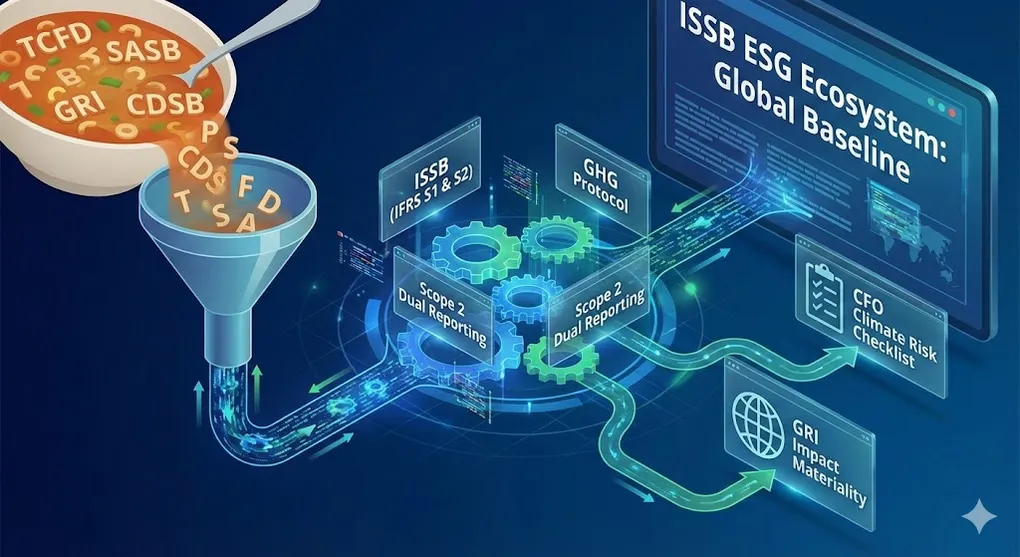
For years, companies faced a confusing maze of sustainability reporting frameworks: TCFD, SASB, GRI, CDP, CDSB… The “alphabet soup” made compliance expensive and comparisons impossible.
The creation of the ISSB (International Sustainability Standards Board) in 2021 marked the beginning of a historic consolidation. The goal isn’t to add yet another standard—it’s to create a Global Baseline that integrates the best of existing frameworks.
This article explains how TCFD, SASB, and GRI fit into the new ISSB ecosystem.
Important Context for European Operations: While ISSB is the global baseline, companies with EU business face stricter requirements under CSRD (Corporate Sustainability Reporting Directive)—which is binding law, not just a standard. The good news: ISSB and the EU have signed an interoperability commitment, so building on ISSB fundamentals prepares you for CSRD as well.
Taiwan Supply Chain Reality: For Taiwanese manufacturers in the Apple, Microsoft, Dell, and other major tech supply chains, customer requirements are arriving faster than regulations. These customers already demand alignment with ISSB/GHG Protocol standards. For many companies, “compliance” is driven by purchase orders, not government mandates.
Part 1: The Architecture — ISSB Built on TCFD
Relationship: Inheritance (The Backbone)
The TCFD (Task Force on Climate-related Financial Disclosures) framework became the structural foundation for ISSB standards.
Complete Integration
ISSB’s first two standards (IFRS S1 and S2) fully adopt TCFD’s four-pillar architecture:
| TCFD Pillar | ISSB Requirement |
|---|---|
| Governance | How the board oversees sustainability risks |
| Strategy | How sustainability issues affect business model |
| Risk Management | How risks are identified, assessed, managed |
| Metrics & Targets | Quantitative disclosures and goals |
The Handover
In 2023, TCFD announced mission accomplished and dissolved. Its monitoring responsibilities officially transferred to ISSB.
What This Means for Companies
If you’ve already been reporting under TCFD, you’ve completed 70-80% of the ISSB framework. ISSB essentially transforms TCFD’s “recommendations” into “mandatory standards” (in jurisdictions that adopt IFRS S1/S2).
Key Upgrade: Financial Connectivity
ISSB goes beyond TCFD by requiring explicit financial connectivity—linking sustainability risks to specific financial statement impacts (revenue, costs, assets, liabilities).
TCFD: "Describe the potential financial impacts of climate risks."
           ↓
ISSB:  "Quantify the current and anticipated financial effects,
        with explicit links to line items in your financial statements."
The Methodology Engine: GHG Protocol
ISSB doesn’t invent emissions metrics from scratch. IFRS S2 explicitly requires measuring greenhouse gas emissions according to the GHG Protocol.
| Component | Source |
|---|---|
| Scope 1 (Direct emissions) | GHG Protocol Corporate Standard |
| Scope 2 (Purchased energy) | GHG Protocol Scope 2 Guidance |
| Scope 3 (Value chain) | GHG Protocol Corporate Value Chain Standard |
GHG Protocol Is Evolving
GHG Protocol is undergoing its largest revision in 20 years, with updates to Scope 1/2/3 definitions expected between 2025-2028. Companies should monitor these changes as they will flow through to ISSB requirements.
Scope 2: The Dual Reporting Requirement
Many companies report a single emissions number, but ISSB (following GHG Protocol Scope 2 Guidance) requires dual reporting:
| Method | What It Measures | When to Use |
|---|---|---|
| Location-Based | Grid-average emission factor for your region | Always required (reflects physical reality) |
| Market-Based | Emissions based on your energy contracts (RECs, PPAs, green tariffs) | Required if you operate in markets with energy choice. Key driver: RE100 commitments—companies joining RE100 must report market-based to prove 100% renewable achievement |
Why This Matters: A company buying 100% renewable energy certificates shows zero market-based Scope 2, but may still show significant location-based emissions. Both numbers tell important stories.
Factor Management: The Version Control Challenge
For data engineers, emission factor management is a version control nightmare. This is one of the most common sources of calculation errors.
| Common Mistake | Why It’s Wrong |
|---|---|
| Using 2023 electricity factors to calculate 2024 emissions | Factors update annually as grid mix changes |
| Mixing IPCC AR5 and AR6 GWP values | AR5 says methane = 28x CO2; AR6 says 27.9x. Small difference, but multiplied across millions of tons, the error is material |
| Applying Taiwan factors to China-manufactured components | Regional factors differ significantly |
Best Practice: Factor Library with Versioning
factor_library/
├── electricity_factors/
│   ├── 2023_v1.0/
│   │   ├── taiwan_taipower.json
│   │   └── usa_epa_egrid.json
│   └── 2024_v1.0/
├── gwp_values/
│   ├── ipcc_ar5.json
│   └── ipcc_ar6.json
└── changelog.md  ← Critical for audit trail
Key Principle: Every calculation must log which factor version was used. When auditors ask “why did your emissions change 5%?”, you need to answer: “3% from operational changes, 2% from updated grid factors.”
Part 2: Industry Specificity — SASB as the Flesh
Relationship: Merger (The Flesh on the Bones)
If TCFD is the skeleton, SASB (Sustainability Accounting Standards Board) provides the industry-specific substance.
Organizational Integration
The IFRS Foundation (ISSB’s parent organization) formally acquired the Value Reporting Foundation (which managed SASB) in 2022. SASB is now part of the IFRS family.
Mandatory Reference
IFRS S1 explicitly requires companies to “refer to” SASB industry standards when identifying sustainability risks and opportunities.
| What ISSB Provides | What SASB Provides |
|---|---|
| General disclosure framework | Industry-specific metrics |
| Cross-industry requirements | 77 industry standards covering material topics |
| Principles for materiality | Sector-specific KPIs (e.g., water recycling rates for semiconductors) |
Example: Semiconductor Industry
Under ISSB + SASB, a chipmaker would disclose:
| Metric (from SASB) | Why It’s Material |
|---|---|
| Water withdrawal in water-stressed regions | Fab operations require massive water usage |
| Energy management | Power consumption is a major cost and emissions source |
| Product lifecycle management | E-waste and recycling obligations |
| Supply chain management | Conflict minerals, geopolitical risks |
One-Sentence Summary: SASB’s industry metrics are now part of ISSB’s standard library, providing the “how to measure” for each sector.
Part 3: The Complementary Partner — GRI and Double Materiality
Relationship: Collaboration (The Other Lens)
Here’s where it gets interesting. GRI (Global Reporting Initiative) was NOT merged into ISSB. They are independent partners serving different purposes.
The Two Pillars of Materiality
| Perspective | Framework | Focus | Primary Audience |
|---|---|---|---|
| Financial Materiality | ISSB | How sustainability issues affect company value | Investors |
| Impact Materiality | GRI | How the company affects the world (people, planet) | Employees, communities, NGOs, regulators |
The Double Materiality Concept
                    ┌─────────────────────────────────────────┐
                    │        DOUBLE MATERIALITY               │
                    │                                         │
    ┌───────────────┴───────────────┐   ┌───────────────────────┴─────────────────┐
    │      ISSB (IFRS S1/S2)        │   │              GRI                        │
    │                               │   │                                         │
    │  "Outside-In"                 │   │  "Inside-Out"                           │
    │  How does climate affect      │   │  How does our company affect            │
    │  our profits?                 │   │  climate and society?                   │
    │                               │   │                                         │
    │  → For investors              │   │  → For all stakeholders                 │
    └───────────────────────────────┘   └─────────────────────────────────────────┘
Interoperability Agreement
ISSB and GRI signed a Memorandum of Understanding (MOU) to ensure:
- Aligned definitions where possible
- Data compatibility to avoid duplicate work
- Clear guidance on how to report under both frameworks
The Future of Sustainability Reports
Expect modular reports: One section satisfying investor-focused ISSB requirements, another satisfying stakeholder-focused GRI requirements—all in a single integrated document.
Interoperability Index: GRI and ISSB have published detailed mapping documents showing how disclosures under one framework can satisfy requirements of the other, reducing duplicate data collection.
Part 4: The Integration Summary
| Framework | Role | Integration Status | What It Means for Companies |
|---|---|---|---|
| ISSB | Global Baseline | Core Authority | Mandatory framework for financial sustainability disclosures (IFRS S1/S2) |
| TCFD | Architecture Source | Fully Absorbed | TCFD’s four pillars are now ISSB’s chapter structure. TCFD dissolved in 2023. |
| SASB | Industry Metrics | Merged | 77 industry standards maintained by IFRS Foundation. Referenced in ISSB disclosures. |
| GRI | Impact Complement | Independent Partner | Parallel reporting for impact materiality. Interoperability agreement in place. |
Part 5: The Formula for Future Sustainability Reports
The consolidation is a convergence, not an added burden.
The ISSB Report Formula
ISSB Report = TCFD Structure + SASB Industry Metrics + Financial ConnectivityComplete ESG Disclosure
Full ESG Picture = ISSB (for investors) + GRI (for stakeholders)Visual Summary: The New Ecosystem
┌─────────────────────────────────────────────────────────────────────────────┐
│                        IFRS FOUNDATION                                      │
│  ┌─────────────────────┐  ┌─────────────────────┐                          │
│  │        IASB         │  │        ISSB         │                          │
│  │  (Financial Stds)   │  │  (Sustainability)   │                          │
│  │  IFRS 1-17, IAS     │  │  IFRS S1, S2        │                          │
│  └─────────────────────┘  └─────────┬───────────┘                          │
│                                     │                                       │
│                    ┌────────────────┼────────────────┐                     │
│                    ▼                ▼                ▼                     │
│            ┌───────────┐    ┌───────────┐    ┌───────────┐                 │
│            │   TCFD    │    │   SASB    │    │    CDP    │                 │
│            │(Structure)│    │(Industry) │    │ (Platform)│                 │
│            │ ABSORBED  │    │  MERGED   │    │ ALIGNED   │                 │
│            └───────────┘    └───────────┘    └───────────┘                 │
│                                     │                                       │
│                              ┌──────┴──────┐                               │
│                              │ GHG Protocol│                               │
│                              │ (Methodology)│                               │
│                              └─────────────┘                               │
└─────────────────────────────────────────────────────────────────────────────┘

                    ↕  Interoperability Agreement  ↕

┌─────────────────────────────────────────────────────────────────────────────┐
│                              GRI                                            │
│                   (Impact Materiality - Independent)                        │
└─────────────────────────────────────────────────────────────────────────────┘
Note on CDP: CDP is a platform (questionnaire system), not a standard. CDP has aligned its questionnaire with IFRS S2, so completing CDP responses now largely satisfies ISSB climate disclosure requirements.
Part 6: Practical Transition Guide
If You Currently Report Under TCFD
| What You Have | What ISSB Adds |
|---|---|
| Four-pillar structure | ✅ Already aligned |
| Qualitative risk descriptions | Quantitative financial impact required |
| Climate scenarios | More granular scenario analysis |
| Emissions data | Scope 1, 2, 3 with methodology disclosure |
Scope 3 Warning: This is the biggest gap. ISSB requires full value chain emissions (Scope 3), though many jurisdictions provide transition relief allowing companies to delay Scope 3 disclosure for the first year.
Gap: Financial connectivity. ISSB requires linking climate risks to specific P&L/Balance Sheet items.
If You Currently Report Under GRI
| What You Have | ISSB Requirement |
|---|---|
| Impact-focused disclosures | Add investor-focused financial materiality |
| Broad stakeholder topics | Focus on enterprise value impacts |
| GRI-specific metrics | Reference SASB industry standards |
Gap: Different materiality lens. You’ll need to reassess which topics are financially material (not just impactful).
If You Currently Report Under SASB
| What You Have | ISSB Requirement |
|---|---|
| Industry-specific metrics | ✅ Directly referenced |
| Sector KPIs | Add TCFD governance/strategy structure |
| Data collection systems | Expand to full IFRS S1/S2 framework |
Gap: Structural framing. SASB provides metrics, but ISSB requires the governance and strategy narrative around them.
The Boundary Conflict: Financial vs. Operational Control
This is the most common source of friction between Finance and Sustainability teams during ISSB adoption.
| Old Practice (GRI/CDP) | ISSB Requirement |
|---|---|
| Operational Control approach: Only count facilities you directly manage | Financial Control or Equity Share: Align with financial statement boundaries |
| Joint venture at 50% ownership? Often excluded | Must include proportionally or fully, depending on consolidation method |
The Problem: Switching from operational control to financial control can significantly change your reported emissions. A company might suddenly need to include (or exclude) major emission sources.
Transition Tip: Before ISSB reporting, reconcile your GHG inventory boundary with your financial statement consolidation scope. Identify joint ventures, associates, and SPVs that may cause discrepancies.
Part 7: CFO Climate Risk Checklist — IFRS Line Item Impact
Core Principle: Climate risk is no longer just a CSR matter. It directly affects asset values, liability obligations, and estimates about the future.
7.1 Non-Current Assets — The Biggest Impact Zone
| Line Item | Standard | Key Questions | Risk Scenario |
|---|---|---|---|
| PPE | IAS 16 | 🔴 Has useful life shortened due to regulations (e.g., fossil fuel phase-outs)? 🔴 Is residual value still realistic? | Coal boiler depreciated to 2040 may need accelerated depreciation if phase-out is mandated by 2030 |
| Intangibles | IAS 38 | 🔴 Are patents becoming obsolete due to green technology? 🔴 Should high-carbon R&D be expensed rather than capitalized? | Combustion engine patents may suffer significant impairment |
| Goodwill | IAS 36 | 🔴 Has cash flow forecast for acquired high-carbon subsidiaries been revised downward? | Acquired cement plant faces carbon tax increases, triggering goodwill impairment |
| Impairment | IAS 36 | 🔴 Do CGU cash flows include projected carbon taxes and transition costs? | Factory in flood-prone area: insurance costs surge, asset value falls below carrying amount |
7.2 Current Assets
| Line Item | Standard | Key Questions | Risk Scenario |
|---|---|---|---|
| Inventory | IAS 2 | 🔴 Is NRV impacted by environmental regulations (CBAM, plastic bans)? Will products be unsellable? | Warehouse full of appliances not meeting new energy efficiency standards requires write-down |
7.3 Liabilities & Provisions
| Line Item | Standard | Key Questions | Risk Scenario |
|---|---|---|---|
| Provisions | IAS 37 | 🔴 Have decommissioning costs increased due to stricter environmental remediation standards? 🔴 Are there onerous contracts that cannot be fulfilled? | Mine closure now requires higher-spec soil remediation, existing provision insufficient |
| Contingent Liabilities | IAS 37 | 🔴 Are there potential lawsuits for climate damages or greenwashing claims? | NGO lawsuit for failing to meet stated reduction targets—disclosure in notes required |
| Emissions Obligations | IAS 37 / Policy | 🔴 If emissions exceed allowances, has the liability for carbon credits been estimated? | Exceeded emission cap—must calculate liability at current carbon credit market price |
7.4 Financial Instruments
| Line Item | Standard | Key Questions | Risk Scenario |
|---|---|---|---|
| Financial Assets | IFRS 9/13 | 🔴 Does fair value of investments (e.g., fossil fuel stocks) reflect climate risk? 🔴 Has ECL model been updated for high-risk borrowers? | High-carbon corporate bonds downgraded, requiring credit loss provision |
| Green Finance | IFRS 9 | 🔴 Do sustainability-linked loans with ESG triggers pass the SPPI test? How are stepped interest rates accounted for? | If emission targets are missed, interest rate increases—recalculate interest expense |
7.5 General Disclosure & Notes
| Check Point | Standard | Key Consideration |
|---|---|---|
| Going Concern | IAS 1 | Under extreme climate scenarios (main factory flooded, core product banned), can the company continue operating? |
| Judgments & Estimates | IAS 1 | Critical: Disclose climate assumptions used in valuations (e.g., “Assumed carbon price of $100/ton by 2030”) |
| Connectivity | IASB Guidance | If sustainability report says “We’re retiring old equipment,” has the useful life in financial statements been adjusted accordingly? Narratives must align. |
7.6 CFO Action Items
Action 1: Align Assumptions with Sustainability
Request “climate scenario parameters” from the Sustainability team (projected carbon prices, electricity cost increases). The assumptions in your valuation models must match what’s stated in the sustainability report.
Action 2: Stranded Asset Scan
List your top 10 high-energy assets or high-carbon product lines by book value. Ask Engineering/Sales: “Will these still be usable/sellable in 2030?” If not, adjust depreciation now.
Action 3: Boundary Reconciliation
Confirm that your GHG inventory scope (operational control vs. financial control) clearly maps to your consolidated entity list. Where there are gaps, assess the impact on “carbon liability” estimates.
Part 8: Critical Immediate Actions
Based on the challenges outlined above, here are three high-priority actions for companies beginning ISSB adoption.
A. CFO-CSO Joint Meeting: Resolve the Boundary Conflict
The Issue: The “Boundary Conflict” is consistently the biggest pain point in ISSB implementation.
Immediate Action: Convene a joint meeting between the CFO and CSO/Sustainability Head.
Agenda Item: Confirm whether the GHG inventory boundary (Operational Control vs. Financial Control) aligns with the financial statement consolidation scope.
| If Misaligned… | The Risk |
|---|---|
| Sustainability report uses Operational Control and excludes certain JVs | But financial statements under IFRS include those JVs in consolidated P&L |
| Result | ISSB considers this data inconsistency—a compliance red flag |
Warning: If your sustainability report excludes a joint venture’s emissions, but your income statement includes that JV’s profits, auditors will question the integrity of your reporting.
B. Scope 3 Data Infrastructure: Move Beyond Excel
The Issue: Scope 3 is the largest gap for most companies, and ISSB’s auditability requirements are unforgiving.
The Problem with Excel:
- No audit trail
- No version control
- Cannot trace a number back to its source document
Recommended Action: Evaluate digital carbon management systems. The goal is not just “calculating a number”—it’s traceability.
| Auditor Question | What You Need |
|---|---|
| ”Where did this supplier’s emission factor come from?” | Link to external database + download date |
| ”How did you calculate this Scope 3 Category 4 number?” | Formula log + source data reference |
| ”Why is this number different from last year?” | Changelog documenting methodology/factor updates |
Mindset Shift: When the auditor asks “how did you get this number?”, you must be able to produce evidence as easily as pulling an invoice.
C. Climate Stress Test: Review the Balance Sheet
Referencing Part 7 (CFO Climate Risk Checklist), conduct a focused stress test on two areas:
1. High-Carbon Asset Review
| Asset Type | Questions to Answer |
|---|---|
| Fossil fuel boilers | Is the depreciation schedule realistic if regulations mandate phase-out by 2030? |
| Diesel vehicle fleets | Should residual values be written down if resale markets collapse? |
| Old high-energy equipment | Does useful life need shortening? (Direct EPS impact) |
2. Goodwill Impairment Scan
| If You’ve Acquired… | The Question |
|---|---|
| Traditional manufacturing subsidiaries | Will future carbon tax costs reduce their cash flow projections? |
| High-carbon business units | Does the CGU impairment test include transition costs? |
| Companies in carbon-intensive regions | Has discount rate been adjusted for stranded asset risk? |
The Bottom Line: ESG is no longer PR storytelling. It directly affects asset values and financial statements. Finance teams must be deeply involved, not just informed after the fact.
Conclusion: From Alphabet Soup to Integrated Ecosystem
The era of fragmented ESG reporting is ending. ISSB represents the maturation of sustainability disclosure—from voluntary initiatives to mandatory, investor-grade standards.
For companies, the message is clear:
- Build on TCFD — If you have it, you have the foundation
- Reference SASB — It’s now officially part of ISSB
- Maintain GRI — For comprehensive stakeholder communication
- Prepare for mandatory adoption — Major jurisdictions are moving toward ISSB requirements
The “alphabet soup” is becoming a coherent language. Your job is to speak it fluently.