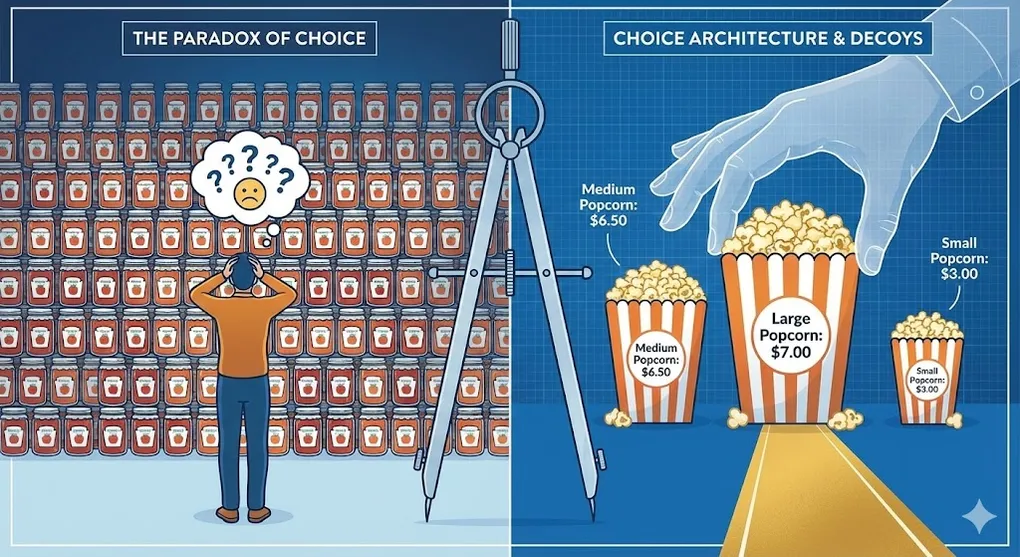
Choice Architecture: Decoys, Defaults, and the Paradox of Choice
The Hidden Power of Choice Design
Every time you present options—whether pricing tiers, product features, or menu items—you’re not just displaying choices. You’re architecting decisions.
“There is no such thing as a neutral design.”
— Richard Thaler & Cass Sunstein, Nudge
This article explores two powerful phenomena:
- The Decoy Effect: How adding an inferior option changes preferences
- The Paradox of Choice: Why more options lead to worse outcomes
Part 1: The Decoy Effect
The Popcorn Experiment
Imagine you’re at the movies:
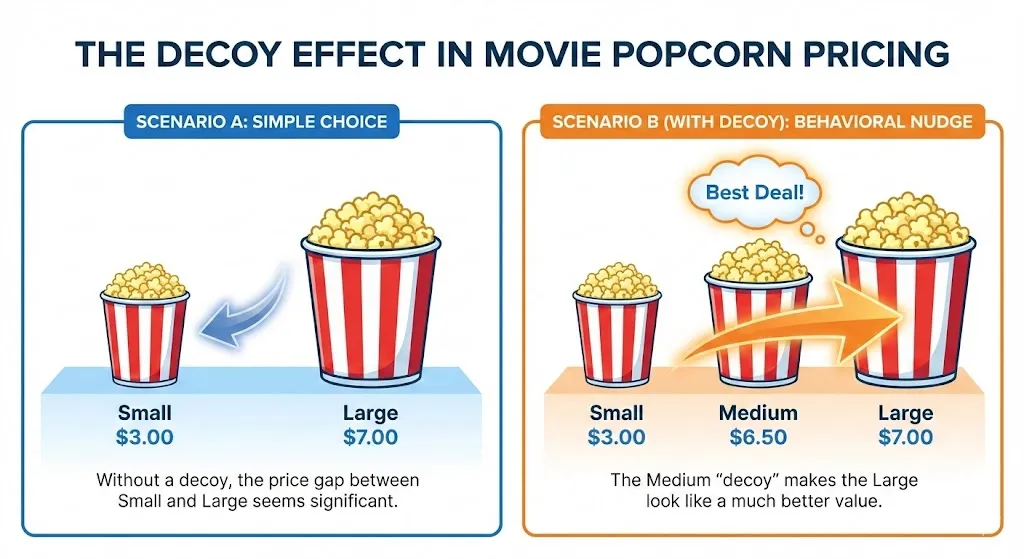
Scenario A: Two Options
| Size | Price |
|---|---|
| Small | $3.00 |
| Large | $7.00 |
Result: Most people buy Small. The Large seems overpriced.
Scenario B: Three Options (with Decoy)
| Size | Price |
|---|---|
| Small | $3.00 |
| Medium | $6.50 |
| Large | $7.00 |
Result: Most people buy Large.
What Changed?
The Medium is a decoy—it’s not meant to be purchased. Its purpose is to make the Large look like a bargain.
The Logic: “Only $0.50 more for a much bigger upgrade? Large is obviously the best deal!”
The brain didn’t actually evaluate whether $7 is reasonable. It compared Large to Medium and declared victory.
The Mathematics of Asymmetric Dominance
The decoy effect works through asymmetric dominance:
| Attribute | Option A | Option B | Decoy (A’) |
|---|---|---|---|
| Price | $5 | $7 | $6.50 |
| Quality | 6/10 | 8/10 | 5/10 |
The Decoy A’ is:
- Dominated by A (worse on both dimensions)
- Not dominated by B (better on price, worse on quality)
This asymmetry makes A look superior, even though B might objectively be better value.
Real-World Applications
Pricing Tiers (SaaS)
| Plan | Price | Features | Purpose |
|---|---|---|---|
| Basic | $9/mo | 5 users | Anchor |
| Professional | $29/mo | 10 users | Decoy |
| Enterprise | $39/mo | Unlimited | Target |
The Professional plan exists to make Enterprise look like a no-brainer for just $10 more.
Subscription Models (The Economist)
Famous A/B test result:
| Option | Price | Result |
|---|---|---|
| A: Web Only | $59 | Popular |
| B: Print Only | $125 | Nobody chose |
| C: Print + Web | $125 | Very popular |
Option B is the decoy—identical price to C but clearly inferior. Its presence made C irresistible.
Restaurant Menus
| Strategy | Implementation |
|---|---|
| High anchor | Place most expensive item first |
| Decoy dish | Slightly worse version of target dish |
| Visual design | Box/highlight the target option |
Detecting Decoys in Your Data
def analyze_decoy_effectiveness(sales_df, decoy_product_id, target_product_id):
    """
    Measure if a suspected decoy is working.

    Signs of effective decoy:
    1. Decoy has low sales volume
    2. Target has elevated sales after decoy introduction
    3. Customers who view decoy are more likely to buy target
    """

    # Decoy purchase rate (should be low)
    decoy_rate = sales_df[sales_df['product_id'] == decoy_product_id].shape[0] / len(sales_df)

    # Target purchase rate among those who viewed decoy
    viewed_decoy = sales_df[sales_df['viewed_products'].str.contains(str(decoy_product_id))]
    target_rate_after_decoy = (
        viewed_decoy[viewed_decoy['purchased'] == target_product_id].shape[0] /
        len(viewed_decoy)
    )

    # Compare to baseline target rate
    baseline_target_rate = (
        sales_df[sales_df['purchased'] == target_product_id].shape[0] /
        len(sales_df)
    )

    print(f"Decoy Purchase Rate: {decoy_rate:.1%} (should be low)")
    print(f"Target Rate After Viewing Decoy: {target_rate_after_decoy:.1%}")
    print(f"Baseline Target Rate: {baseline_target_rate:.1%}")
    print(f"Decoy Lift: {(target_rate_after_decoy/baseline_target_rate - 1)*100:.1f}%")

    # ADVANCED: Check for cannibalization
    # Did the decoy steal from the premium tier instead of lifting the target?
    if 'premium_product_id' in sales_df.columns:
        premium_id = sales_df['premium_product_id'].iloc[0]
        premium_before = sales_df[sales_df['period'] == 'before']['purchased'].value_counts().get(premium_id, 0)
        premium_after = sales_df[sales_df['period'] == 'after']['purchased'].value_counts().get(premium_id, 0)
        if premium_after < premium_before * 0.9:
            print(f"⚠️ Warning: Premium sales dropped {(1 - premium_after/premium_before)*100:.0f}%. Check for cannibalization.")

    return {
        'decoy_rate': decoy_rate,
        'target_lift': target_rate_after_decoy / baseline_target_rate
    }
Part 2: The Paradox of Choice
The Jam Experiment
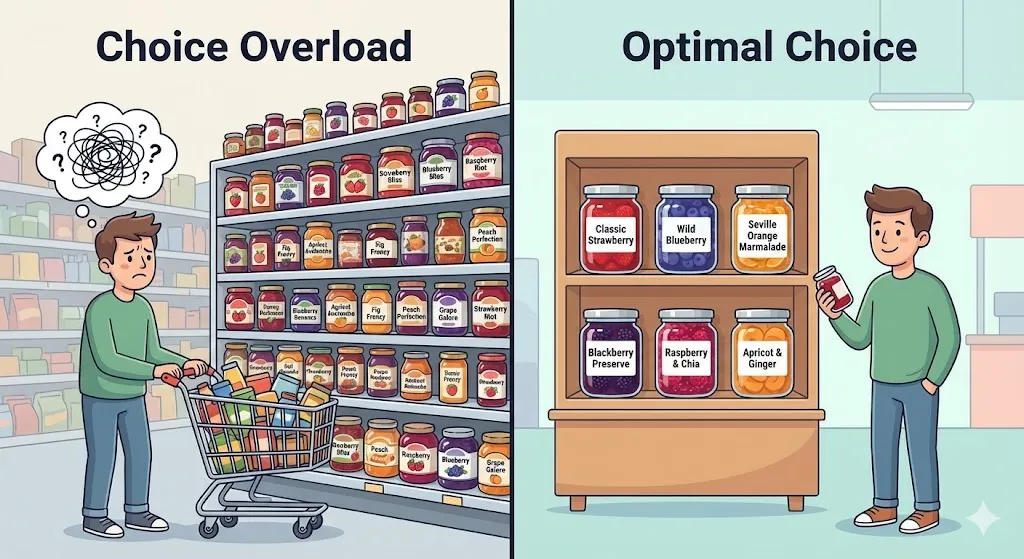
Psychologist Sheena Iyengar set up jam tasting booths at a grocery store:
| Condition | Jams Displayed | Tasted | Purchased |
|---|---|---|---|
| Many Options | 24 varieties | 60% stopped | 3% bought |
| Few Options | 6 varieties | 40% stopped | 30% bought |
10x higher conversion with fewer options.
Why More Choice Fails
| Problem | Mechanism |
|---|---|
| Decision Fatigue | Brain has limited processing capacity |
| Analysis Paralysis | Overwhelmed, people defer decision |
| Regret Anticipation | More options = more paths not taken |
| Satisfaction Reduction | Counterfactual thinking (“What if I chose wrong?”) |
The Costco Model
Costco intentionally limits selection:
| Traditional Supermarket | Costco |
|---|---|
| 30,000+ SKUs | ~4,000 SKUs |
| 20 types of ketchup | 2 types of ketchup |
| Choice anxiety | ”Just grab and go” |
Result: Higher sales volume per SKU, faster shopping, higher satisfaction.
The Apple Approach
Steve Jobs’ return to Apple in 1997:
| Before (1997) | After |
|---|---|
| Dozens of Mac models | 4 products (2×2 matrix) |
| Confusing naming | Clear: Consumer/Pro × Desktop/Portable |
| Customer confusion | Clear purchase path |
“Deciding what not to do is as important as deciding what to do.”
— Steve Jobs
Optimal Choice Architecture
Research suggests optimal ranges:
| Context | Recommended Options |
|---|---|
| Primary choices | 3-5 options |
| Configurations | 7±2 attributes |
| Menu categories | 5-7 per section |
⚠️ Single Option Aversion: Don’t reduce to 1 option. Humans need autonomy—the feeling of “having chosen.” When there’s only one option (Hobson’s Choice), people often walk away entirely. 3 is usually the magic number.
Managing Choice Overload
| Strategy | Implementation |
|---|---|
| Categorization | Group options into meaningful categories |
| Defaults | Pre-select the most common choice |
| Recommendations | ”Most Popular” or “Best For You” |
| Progressive Disclosure | Show basics first, details on demand |
| Elimination Tools | Filters, comparison tables |
Combining Decoys and Choice Reduction
The most effective choice architecture uses both principles:
The Rule of Three
Offer three options:
- Anchor (Low): Establishes floor
- Decoy (Middle): Dominated by target
- Target (High): Your preferred outcome
Example: Consulting Proposal
| Package | Price | Deliverables |
|---|---|---|
| Basic Audit | $5,000 | Report only |
| Standard Engagement | $18,000 | Report + 2 workshops |
| Premium Partnership | $20,000 | Report + 4 workshops + ongoing support |
Standard exists to make Premium look like incredible value.
Smart Defaults: The Final Nudge
Once you have three options, which one should be pre-selected?
| Default Strategy | When to Use |
|---|---|
| Middle option | When you want balanced conversion |
| Target option | When you want maximum revenue |
| ”Most Popular” badge | When you want social proof without pre-selection |
| ”Recommended for you” | When you have personalization data |
Why Middle Works: The middle option avoids “extremeness aversion”—people instinctively avoid the cheapest (seems low quality) and most expensive (seems extravagant). Pre-selecting the middle as “Recommended” can boost conversion by 20-40%.
| Plan | Price | Conversion without Default | Conversion with “Recommended” |
|---|---|---|---|
| Basic | $9 | 35% | 25% |
| Pro ✅ | $29 | 40% | 55% |
| Enterprise | $99 | 25% | 20% |
This is Nudge at its core: making the desired behavior the path of least resistance.
Detecting Choice Overload in Data
def detect_choice_overload(funnel_df):
    """
    Analyze if choice overload is hurting conversion.

    Signals:
    1. High browse-to-exit ratio on selection pages
    2. Long time-on-page but low conversion
    3. Correlation between options viewed and abandonment
    """

    # Time on selection page vs. conversion
    selection_page = funnel_df[funnel_df['page_type'] == 'product_selection']

    converters = selection_page[selection_page['converted'] == True]
    non_converters = selection_page[selection_page['converted'] == False]

    print("Choice Overload Indicators:")
    print(f"  Avg time (converters): {converters['time_on_page'].mean():.1f}s")
    print(f"  Avg time (non-converters): {non_converters['time_on_page'].mean():.1f}s")

    # If non-converters spend MORE time, that's choice paralysis
    if non_converters['time_on_page'].mean() > converters['time_on_page'].mean() * 1.5:
        print("  ⚠️ Non-converters spending significantly more time")
        print("     → Likely choice overload / analysis paralysis")

    # Options viewed vs. conversion
    correlation = selection_page['options_viewed'].corr(selection_page['converted'].astype(int))
    print(f"  Correlation (options viewed ↔ conversion): {correlation:.3f}")

    if correlation < -0.1:
        print("  ⚠️ Negative correlation: More options viewed = less likely to buy")
        print("     → Consider reducing options or adding guided selection")

    return {
        'time_ratio': non_converters['time_on_page'].mean() / converters['time_on_page'].mean(),
        'options_conversion_corr': correlation
    }
Summary: Choice Architecture Principles
| Principle | Application |
|---|---|
| Less is more | Limit primary options to 3-5 |
| Strategic decoys | Add inferior option to boost target |
| Smart defaults | Pre-select the best choice for most |
| Progressive disclosure | Hide complexity until needed |
| Categorize | Group choices into digestible sets |
| Recommend | Guide users toward optimal path |
Further Reading
- 📖 The Paradox of Choice — Barry Schwartz
- 📖 Nudge — Richard Thaler & Cass Sunstein
- 📄 Iyengar & Lepper (2000). When Choice is Demotivating
- 📄 Ariely, D. (2008). Predictably Irrational (Chapter on Decoys)